


 By P. Fabio ATTARD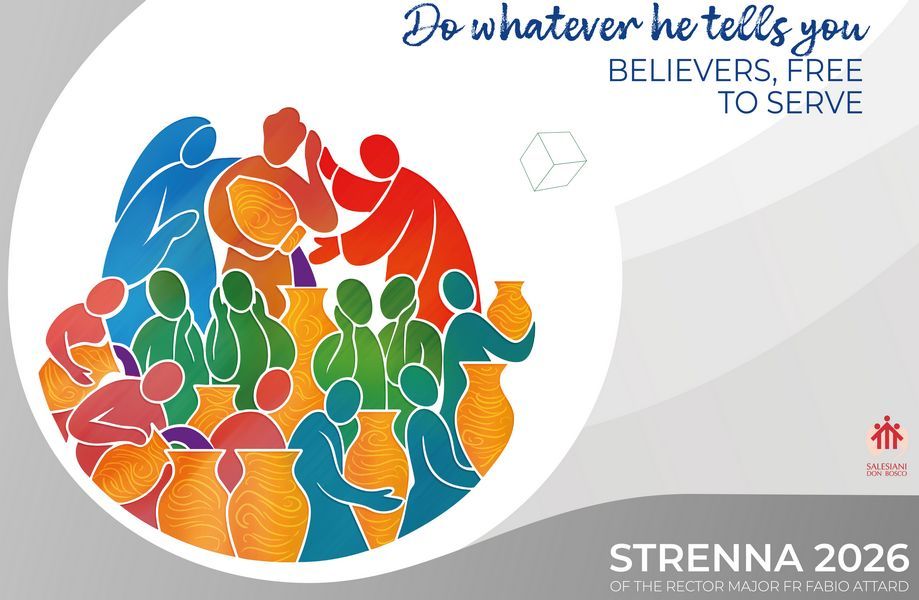
Reading time: 41 min.
Strenna 2026. ‘Do whatever he tells you’
Believers, free to serve
Commentary on Strenna 2026
Introduction
a. Jesus’ first sign is a ‘gateway’
b. God’s final breaking into history
c. Jesus inaugurates a relationship of love, a covenant of kindness and abundance
1. LOOK – Welcoming the signs of the times
a. Mary was not a ‘neutral’ guest.
b. Challenges and difficulties must be recognised and addressed, not set aside
c. History is the treasure chest that reveals God’s action.
d. Invitation to reflection
2. LISTEN – With deep roots in faith in Christ
a. Events must be read and experienced in the light of Christ
b. God’s will emerges from the events we experience
c. A process nourished and enlightened by the Word
d. Invitation to reflection
3. CHOOSE – Living the call with freedom
a. Listening freely with complete trust
b. Every action makes sense – logos – only in and from the Word – Logos
c. The risk of a faith that adapts to the dominant culture
d. Invitation to reflection
4. ACT – Serving with total generosity
a. Serving freely because we are deeply-rooted in Christ
b. Co-workers in God’s plan for the young
c. The boldness of faith
d. Invitation to reflection
5. 150 years – Salesian Cooperators: Don Bosco’s prophetic dream continues
6. Some pastoral proposals
1. ‘Do whatever he tells you’: towards a pedagogy of personal listening
2. Mary at Cana: educator of genuine freedom
3. The art of reading the signs of the times with young people
4. Choosing: Christian freedom as a vocational response
5. 150 years of the Salesian Cooperators: a model for today
Conclusion
My dear confreres,
Daughters of Mary Help of Christians
All members of the Salesian Family,
Young people,
Every year the appointment with the STRENNA offers the opportunity for all the Groups of the Salesian Family to come together around a particular theme, to share and experience powerful moments of prayer and reflection, of listening and fraternity. It is my wish and hope that each Group – and the individuals within it – may find nourishment for their journey and support for their educational, pastoral and personal experiences.
Introduction
The STRENNA that accompanied us last year, built around the Jubilee theme of hope, offered all of us the opportunity to look at the mystery of Christ as a source of light that helps us contemplate the wonders of God in the present moment. We experienced moments that strengthened our faith in what the Lord still has to reveal to us, and we have perceived hope as the strength of the ‘already’ and the courage of the ‘not yet’. We also contemplated how the power of hope, for Don Bosco, helped and sustained him on his journey of discovery and implementation of God’s plan.
150 years ago, hope was the driving force of Don Bosco’s pastoral heart, a heart capable of reading the signs of the times and looking at the world sustained by faith in God. The commemoration of the 150th anniversary of the first Salesian missionary expedition is not intended to be a celebration limited to a chronological moment. In recalling this historical moment we have contemplated how the spirit of God found an open and available heart in Don Bosco. Don Bosco’s response was capable of surpassing a narrow and self-referential perspective on life.
Don Bosco lived in Turin, but his heart and mind inhabited the entire world. His was a hope founded on the certainty – once he discovered God’s plan – that there is no other way but to follow his will to the end. Contemplating the theological virtue of hope that animated his life, we can glimpse what his first disciples already heard and later commented on: Don Bosco a man of faith, Don Bosco a believer, ‘Don Bosco with God’.
This year I would like to propose, as the Strenna, the theme of faith. It emerged gradually but clearly at the beginning of June 2025 when the various Groups of the Salesian Family met for the World Advisory Council meeting. The shared reflections indicated the theme of faith: not only as a natural continuation of hope but as the ‘foundation’ of it. If the power of hope is based on faith, a life truly filled with hope leads to a deeper and more authentic relationship of faith with Jesus, the Son of the Father, who became man for us and continues to be present among us through the power of the Spirit. It will therefore be like a pilgrimage in the faith of the entire Salesian Family: renewing ourselves together, living in the world as Christians (and Salesians) together.
In his first Encyclical Letter Lumen Fidei, Pope Francis offered some very pertinent insights in this regard[1]. First, as a general introduction to the theme of faith, Pope Francis invited us to change our perspective: faith is not something theologically distant, but rather ‘a light to be discovered.’ Believing, living by faith means wanting to walk in the light. Faith, then, is the foundation we have and the path we take because we really want to live life in a beautiful and healthy way. Embracing faith expresses that deep desire to live in the light, refusing to live in darkness, emptiness, and meaninglessness. Pope Francis writes that this call ‘to see once again that faith is a light’ is something we want to pursue, ‘for once the flame of faith dies out, all other lights begin to dim. The light of faith is unique, since it is capable of illuminating every aspect of human existence.’ (no. 4)
This first invitation challenges us directly when we recognise that our mission is to educate to faith and in faith. The challenge that immediately arises is very clear: how can we do this if this source of light within me is growing dim? How can we remain calm when we realise that extinguishing the light in our hearts means, in the long run, leaving young people and all those we accompany in the deepest darkness?
In addition, this light has certain characteristics that should be mentioned. These are characteristics that serve as necessary anchors in hard and difficult moments in the journey of faith.
First of all, for it to be powerful, the light of faith ‘cannot come from ourselves but from a more primordial source: in a word, it must come from God.’ (no. 4). It is not just a matter of offering human, intelligent and professional services, but much more than that. And so this light is not ours, but is granted to us.
There is a second aspect, the result of this extraordinary divine generosity, and Pope Francis describes it in terms that are both profound and tender: ‘Faith is born of an encounter with the living God who calls us and reveals his love, a love which precedes us and upon which we can lean for security and for building our lives.’ Faith is not a product. It is born not so much ‘from the encounter with God’, but ‘in the encounter with God.’ An encounter that should be experienced as an expression of complete freedom and as a continuous source that nourishes us with its light.
This brief introduction already lays the necessary foundations for placing the theme of faith within a relational dynamic. A dynamic that is typical of our Salesian charism. The experience of faith in the encounter with Jesus, Son of God, emerges as the backbone of our actions through the power of his Spirit. Through this Trinitarian energy, we are the first beneficiaries of that gift which gives form and meaning to all that we are, and consequently to all that we do and propose for the salvation of young people.
‘DO WHATEVER HE TELLS YOU’
Believers, free to serve
Let us allow this year to be guided by words from the Gospel of John spoken by Mary at the very beginning of the Gospel itself. What was supposed to be a wonderful wedding reception is marred by a problem: there is a shortage of wine. Faced with the possibility that a celebration might turn into a failure, we find the reaction that comes from Mary’s heart: someone must intervene. And what Mary does is simply present the real situation to Jesus. But his hour, Jesus’ hour, has not yet come. Mary, the caring mother, with great serenity invites the servants just to listen to what Jesus will say to them when ‘his hour’ comes.
This year I propose that we accept Mary’s invitation with the same attitude of openness and freedom that we see in the servants. We too, members of the various Groups of the Salesian Family, must remember the truth of our choice and identity: we are servants, mere servants. And Mary says to us today: ‘Do whatever he tells you.’ Whatever Jesus tells us, we must simply accept it, take it on board and live it, without ifs or buts.
I invite all of you, dear sisters and brothers, after having experienced the power of hope, that ‘hope that does not disappoint’, to allow Mary’s words to reach our hearts, and to turn our gaze and our listening to Jesus, to what he will say to us, in the awareness and joy of being servants.
We want to be sustained by the same faith in filling the jars to the brim, in bringing the water turned into wine to the daily realities we live in and share with everyone. As many of us find ourselves on the front line in difficult situations and critical places, we recognise the risk of weak faith, sometimes even absent faith, with the dramatic consequences that we then see, of a failure to share the ‘wine’ of kindness, empathy and love.
Gospel of John, 2:1-11
On the third day there was a wedding in Cana of Galilee, and the mother of Jesus was there. Jesus and his disciples had also been invited to the wedding. When the wine gave out, the mother of Jesus said to him, ‘They have no wine’. And Jesus said to her, ‘Woman, what concern is that to you and to me? My hour has not yet come.’ His mother said to the servants, ‘Do whatever he tells you.’
Now standing there were six stone water-jars for the Jewish rites of purification, each holding twenty or thirty gallons. Jesus said to them, ‘Fill the jars with water.’ And they filled them up to the brim. He said to them, ‘Now draw some out, and take it to the chief steward.’ So, they took it. When the steward tasted the water that had become wine, and did not know where it came from (though the servants who had drawn the water knew), the steward called the bridegroom and said to him, ‘Everyone serves the good wine first, and then the inferior wine after the guests have become drunk. But you have kept the good wine until now.’
Jesus did this, the first of his signs, in Cana of Galilee, and revealed his glory; and his disciples believed in him.
Let us enter into the heart of the passage that inspired the title of this STRENNA, with a meditation on the first ‘sign’ that Jesus performed at Cana in Galilee, as recounted by John (2:1-11).
Three brief introductory reflections offer us the ‘hermeneutic’ key that makes the piece significant for our personal and community experience.
a. Jesus’ first sign is a ‘gateway’
In one of his audiences Pope Francis commented on this passage with a very concrete image. He says that Jesus’ first sign is ‘a sort of “gateway”, on which are engraved the words and expressions that illuminate the entire mystery of Christ and open the hearts of the disciples to the faith.’[2] Jesus’ first sign is not a spectacle to be admired, but rather an invitation addressed to the heart of every believer. In it, we find a reference to those attitudes that ensure the acceptance of the proposal of faith in him, as evoked at the end of the passage: ‘his disciples believed in him.’ (v. 11) This first sign at Cana goes straight to the heart of Jesus’ message: the invitation to stake our lives on his word. Today, ‘Cana’ is the house where we live, the work where we carry out our mission, the group of young people, teachers and parents whom we accompany. We are the servants and disciples of various actual and everyday experiences.
And as at Cana, Mary continues to have a fundamental and founding mission in this process today. It is she who, by walking with us, invites us to take the step of faith, a faith freely assumed in order to be authentic servants. And this same process consisting of faith, freedom and service, is the same one that Don Bosco experienced throughout his life. Ever since his dream at the age of nine, Don Bosco recognised Mary as the Mother and Teacher who supported him in his faith and gave him the courage to be a free servant to young people in the field she had indicated.
b. God’s final breaking into history
A second point for reflection is offered by Pope Benedict XVI starting from the words that introduce this first sign: ‘On the third day there was a wedding in Cana of Galilee.’ (v.1)
In his book Jesus of Nazareth, Pope Benedict says that here we find ourselves at the heart of the mystery of God revealing himself. The temporal indication is a symbol of all God’s action in history. The ‘third day’ communicates the anticipation of the fulfilment of the history of salvation that takes place in Christ’s resurrection on the third day. At this precise moment, says the Pope, we have ‘the definitive irruption of God upon earth.’ Cana is a place that, in a humble and hidden way, contains the fulfilment of the project of God’s love for humanity[3]. Cana is every place where we are sent, as a space where God continues to make himself present through those who hear his word, believe it and live it.
This reflection has truly significant implications for us. If ‘Cana’ is every place we live, then we are the ones whom the Lord calls to be signs and bearers of his love for young people, for humanity. Certainly, ‘the irruption of God upon earth’, his breaking into history, does not depend on us, but we are given the opportunity to facilitate it as a gift freely received and freely accepted. Every generous action we take contributes to God’s plan… but every act of resistance or refusal we make risks denying others that ‘good wine’.
c. Jesus inaugurates a relationship of love, a covenant of kindness and abundance
A third introductory point, also drawn from Pope Benedict XVI: the setting of the ‘wedding’ feast is the most appropriate dimension that characterises God’s relationship with all humanity, the wedding covenant par excellence.[4]
In truth, we realise that Jesus does not simply come to leave us a message. Through this first sign, what Jesus is about to inaugurate is a relationship of love, a covenant of kindness and abundance. Jesus invites us to enter into a living, life-giving relationship. With him, we inhabit a sacred space where, first and foremost, we discover that we are loved. In this loving relationship we are positively challenged and encouraged to follow him.
Recognising that we are always searching for that ‘good wine’ that never fails, there is only one path to follow, the one indicated by Mary: ‘Do whatever he tells you.’ The wedding feast on the one hand inaugurates a new reality and, on the other, confers a seal on the new and eternal covenant.
We can say that the experience of Cana is a true ‘womb’ in which God’s faithfulness comes to meet us, completing and bringing to fulfilment man’s search for love. This means that when the time comes, Jesus responds to the suggestion by obeying (ob-audire), by listening to the faith, lived faithfully.
The banquet thus becomes the altar that generously distributes the new wine of the Word. A generous distribution, the fruit of faith lived with freedom. Following Mary’s invitation, this life illuminated by the Word of Jesus is lived in the form of service for the good of all, with complete openness of heart.
In light of the passage about the wedding at Cana, STRENNA 2026 presents us with various challenges. I am convinced that the call for every group of the Salesian Family to live its charism more fully finds further inspiration in this passage from the Gospel to be lived for the benefit of young people and all those who share in the Salesian mission. Not only that, but also to serve many people in various parts of the world to whom the Lord asks us to bring the wine of hope, the joy of communion.
1. LOOK – Welcoming the signs of the times
The first call I invite you to accept and reflect on concerns Mary’s attitude: the woman who was attentive to what was happening around her. The Gospel simply tells us that ‘on the third day there was a wedding in Cana of Galilee, and the mother of Jesus was there’ (v. 1). The Gospel gives no further information. But when we listen to these few words and connect them with her reaction, we begin to glimpse some significant elements of Mary’s heart.
a. Mary was not a ‘neutral’ guest.
She was attentive and alert to everything that was happening around her. In figurative but meaningful terms, we can say that Mary embraced the time and history of those who wanted her as a guest at their wedding feast. Mary could easily feel that she should not interfere, even though she sensed the sad consequences of running out of wine. Yet she chose not to remain indifferent.
Here is a first aspect that we, as followers of Jesus, are called to ask ourselves: to what extent do we feel challenged by the events of history that we are experiencing and in the places where we live? What position do we take when we could also choose to remain distant because, on certain matters, ‘it’s not up to me’ or ‘it’s not my responsibility’?
In the light of what Mary did, faced with the challenges that surround us, we feel deeply and personally challenged. In a culture of anonymity and indifference, we recognise that we too risk making choices based on ‘political correctness’!
Embracing time and history as an existential attitude implies certain requirements that we can only grasp and assume in the light of faith in Christ.
In the field of pastoral education, Mary’s choice is a strong yet gentle reminder for us not to fall into indifference which not only justifies things but also passively and indirectly encourages them. How often do we find even so-called ‘churchgoers’ who, when faced with the plight of refugees, the poor and the vulnerable, retreat into their comfortable lives, considering them only a nuisance and a burden?
b. Challenges and difficulties must be recognised and addressed, not set aside
This is what Mary did at Cana. How often does it happen, when faced with unexpected situations of hardship, that instead of tackling them with serenity and apostolic passion we distance ourselves from them, justifying ourselves all too easily! The danger is that this pastoral inertia may gradually become part of our ‘culture’ too. We wait – and insistently demand – for others to do their part, perhaps blaming them, and in this way we believe we can numb our consciences, pretending to believe that we have nothing to offer, or that we are not involved.
When the poor knock on our door, we cannot pretend not to notice. For our father and teacher Don Bosco, his response did not stem from calculating the means, but from the openness of his heart, which was in tune with the young people of his time. Right from the start he was moved by the desire to get in touch with them, poor and needy as they were. Let us be careful not to get caught up in the prospect of a consecrated and pastoral life that is strongly influenced by a bourgeois and selective mentality. We do not choose the poor, but they are sent to us by Providence. Welcoming poor young people and doing everything possible for them is a calling that we must take seriously.
c. History is the treasure chest that reveals God’s action.
A third insight we gain from Mary’s action is the awareness that in small and humble moments, when lived with generosity, history becomes a treasure chest that reveals God’s action. A simple motherly gesture, a solicitous invitation to the servants, prepare the ground for Jesus’ hour, for his first sign. How much the Lord surprises us when we pay attention to the details of human existence, especially when we are with the poor and needy! How many lives have experienced the balm of God’s mercy through gestures of care from educators who, with motherly kindness, have offered a smile or a word of encouragement instead of looks of condemnation or humiliating words!
Don Bosco’s entire experience tells us that ‘the courtyard, the playground’, both physical and metaphorical, is the place where God’s goodness is revealed. We communicate loving-kindness by living it serenely when we are present among and for young people, who thus feel recognised, appreciated and loved. Sharing is built into our relationships with those who work with us when they ask us for those ‘five minutes’ of listening. Pastoral and educational wisdom is conveyed through everyday gestures, experienced with an open, receptive, attentive and affectionate heart.
It is worth recalling here a reflection that is more relevant than ever, offered by Salesian Dominic Veliath on the context of South Asia[5]. He writes:
The Salesian charism is still on a pilgrimage. Every pilgrimage involves a certain amount of risk; at times one is challenged to venture along what may seem as yet an uncharted course. It is in this setting that every Salesian, including the Salesian in the South Asian context, confident in the abiding presence of the Spirit of God, rooted in the Salesian charism and in fraternal communion with the Salesian congregation at large, is called to continue his journey with a little of that trust which has so insightfully been described by the poet Antonio Machado in his poem ‘Caminante no hay Camino’: ‘Wayfarer, there is no way, the way is made by walking’.
Mary, the woman attentive to what was happening around her, invites us not to remain distant and indifferent to the needs of those whom the Lord asks us to accompany.
d. Invitation to reflection
– As communities and groups, let us ask ourselves if we have spaces and times where we can reflect together on the poverty that surrounds us.
– Let us ask ourselves whether our lifestyle is truly an authentic witness to those who know us, to those we serve, who are sometimes truly poor in body and soul.
– Let us ask ourselves whether the poor are numbers and objects of ideology and pastoral strategy, or whether we are servants to them with the means we have. How generous are we with our ‘five loaves and two fish’?
2. LISTEN – With deep roots in faith in Christ
Mary, attentive to what was happening around her, said to the servants, ‘Do whatever he tells you.’ (v. 5) The invitation is clear and simple. But we know it’s also very challenging. It is not only a matter of recognising events with their urgent moments and necessities, but of interpreting them in the light of faith in Christ. Most of the time, we interpret events correctly, professionally and competently, with analyses that are generally well developed and accurate, at a ‘horizontal’ level, so to speak. But for those of us who follow Jesus, this level – which must never be lacking – must absolutely be accompanied by the ‘vertical’ one. How easy it is, in responding to various emergencies, to embark on a frenetic course of action in favour of the poor and needy, and in the long run, we often end up being sucked into a vortex of activism that leaves us no time to look at the faces of those we want to serve, nor even the face of the One who called us to serve them in his name!
a. Events must be read and experienced in the light of Christ
Mary invites us to respond in a way that certainly addresses the unexpected difficulty, but with a very clear instruction: ‘Do whatever he tells you.’ The primary emphasis is not on what must be done, but on the One who says what must be done! Events should be read and tackled in the light of Christ. This is an undeniable indication as well as a source of real energy for those who believe. There are different ways to respond to poverty. The believer opts for this: to act starting from the Word of Jesus. For those who believe in Christ, what many saints of charity have passed on through their lives and witness applies. Our father Don Bosco himself passed this on in a clear way: to act in the name of Jesus.
It is of great importance to us how much the first Salesians preserved the figure of Don Bosco in their memory, especially in his most profound spiritual and mystical aspects. In an article of the Salesian Constitutions, Article 10, which opens the section on the Salesian spirit, we find a summary of this calling that Don Bosco lived in an authentic way:
Article 10:
Under the inspiration of God, Don Bosco lived and handed on to us an original style of life and action: the Salesian spirit.
It is summed up in and focused on pastoral charity, characterized by the youthful dynamism which was revealed so strongly in our Founder and at the beginnings of our Society. It is an apostolic zeal that drives us to seek souls and serve God alone.
b. God’s will emerges from the events we experience
In this dynamic, which is deeply rooted in Christ, an experience unfolds that gradually reveals God’s plan to us. God’s will emerges from within our collaboration in the events we experience in him and because of him. And when we are sincere and act according to his gaze, the Lord of life always surprises us in the most unexpected ways. Believing, then, is not a choice that guarantees success and triumph; believing is placing oneself in his hands, growing in the sure certainty that comes from a heart guided by divine providence. If this radical choice is replaced by the logic of calculation, then everything takes a different direction, the destination of which we do not know. Mary remains the guide of total and trusting faith. That is how she was, and that is how she continues to be.
In the Gospel passage we are meditating on, we find no words of doubt or mistrust, or even resignation on the part of the servants: only gestures of complete and total trust:
His mother said to the servants, ‘Do whatever he tells you.’
Now standing there were six stone water-jars for the Jewish rites of purification, each holding twenty or thirty gallons. Jesus said to them, ‘Fill the jars with water.’ And they filled them up to the brim. He said to them, ‘Now draw some out, and take it to the chief steward.’ And they brought them to him. (vv. 5-8)
These verses convey – in the total silence of the protagonists in the account – a willingness, readiness and generosity that may leave one somewhat perplexed. But no! It is the reaction of those who choose to stake their lives on the Word they have heard. It is the position of those who truly believe. It is the choice of those who do not stand there asking questions or, worse still, setting conditions. Here is the faithful servant!
c. A process nourished and enlightened by the Word
Finally, let us note something that we believers must not lose sight of: this is a process that endures because it is continually nourished and enlightened by the Word. Interpreting everything in the light of God and contemplating his will in the events that unfold before us is not something that happens automatically. It requires a heart attuned to the power of the Word. This is a need that in a culture like ours – where efficiency takes precedence over efficacy and where the result is considered more important than the process – we constantly risk underestimating, proceeding directly to action, even with the best of intentions. The consequence is that the point of reference – the Word meditated upon and contemplated – becomes increasingly weaker and, in the long run, is even considered a waste of time.
How often do we hear, even in our religious communities, that we do not have time for meditation because we are so busy with pastoral commitments? And the greater our commitments become, the more we abandon our friendship with the Word. Unfortunately, the result is a pastoral self-referentiality that is reinforced in the name of pastoral activity and commitments. In line with what Pope Francis once defined as ‘spiritual worldliness’, we run a very similar risk, the dead end of ‘pastoral worldliness’. That is, we do God’s work with great commitment, but in the long run we forget the God who initially called us to serve him. What a tragedy when, believing we are serving God in the poor, we end up justifying his own irrelevance. We end up idolising our own pastoral projects!
I would like to offer here a reflection on the power and centrality of the Word of a saint of charity whom many of us have encountered: Mother Teresa of Calcutta. She writes to her sisters words that are also valid for us today:
I worry some of you still have not really met Jesus—one-to-one— you and Jesus alone. We may spend time in chapel—but have you seen with the eyes of your soul how He looks at you with love? Do you really know the living Jesus—not from books, but from being with Him in your heart? Have you heard the living words He speaks to you? Ask for the grace, He is longing to give it. Never give up this daily intimate contact with Jesus as a real living person—not just an idea. How could we spend a single day without hearing Jesus say to us: I love you? It is impossible. Our soul needs it as much as our body needs to breathe. Otherwise, prayer dies and meditation degenerates into reflection. Jesus wants each of us to listen to him and speak to him in the silence of our hearts. Be vigilant about anything that could prevent this personal contact with the living Jesus.[6]’
The warm invitation of Saint Teresa of Calcutta is addressed to anyone who wishes to make faith the source of their identity and actions. Being believers places us at the heart of history so that, as protagonists, we may welcome and live history and in history in the light of Christ. Only in this way – nourished and fed with the food of the Word – will we be able to observe with amazement how God’s will emerges more clearly before our eyes.
d. Invitation to reflection
– Do we recognise how easy it is to respond to the needs of the poor and offer educational and pastoral processes without first making a human and spiritual assessment of the situation?
– As communities and groups, do we recognise the urgent need to have the courage to ‘waste’ time reflecting and praying before acting? The value of the proposals lies in the roots that nourish the tree so that it bears good and lasting fruit.
– Have we internalised that serving the poor is a consequence of our encounter with Christ, because they themselves bring us back to him to serve them even more?
– Do we constantly realise that the danger of ‘pastoral worldliness’ ultimately feeds our ego, with the result that instead of serving the poor, we end up using the poor?
3. CHOOSE – Living the call with freedom
The story of the ‘sign’ at Cana offers further insights that shed more light on our lived experience of faith, as a guide and reminder for our educative and pastoral journeys. The servants listen, welcome and obey, as Mary had asked them to do. Their attitude and choices are like the fulfilment of another statement by Jesus, when – in Luke’s account of the ‘woman in the crowd [who] raised her voice and said to him: “Blessed is the womb that bore you and the breasts that nursed you!” but he said, ”Blessed rather are those who hear the word of God and keep it!”’ (Lk 11:27-28).
Here is the point on which everything turns. It is important and decisive to feel part of human history, welcoming and ‘reading’ the signs of the times; it is absolutely necessary to be deeply-rooted in faith in Christ. But the truth of these two attitudes is most evident when we accept and live by the Word. What emerges, then, is the path of authentic faith, marked by healthy and solid growth.
a. Listening freely with complete trust
The point on which everything turns is marked by free listening characterised by complete trust. The words in the Gospel have a very powerful impact and a meaning that is always relevant.
Jesus said to them, ‘Fill the jars with water.’ And they filled them up to the brim. He said to them, ‘Now draw some out, and take it to the chief steward.’ So they took it (Jn 2:7-8)
When someone trusts in Jesus, there is no room for anything else. Indeed, human availability becomes even fuller and more joyful, more ready and generous. The author of the Gospel provides a detail that, as educators and pastors, we cannot fail to notice: ‘they filled (the jars) up to the brim.’ (v. 7) To the brim, beyond the already large quantity of litres in the jars. It is always worthwhile to be generous, with an ‘overflowing’ generosity. When Jesus calls, we go forward in this way, obeying – ob-audire – freely and without measure, again and again, as the Gospel continues: ‘He said to them, “Now draw some out, and take it to the chief steward.”’ So they took it’ (v. 8)
I believe that many of us, in our lives, as children and young people but also as adults, have had the joy of meeting people who remind us of the generosity of these servants. People we still carry in our hearts and minds, not so much for the things they did, but for the free and generous attitude they passed on to us. They certainly left their mark on us, because their hearts were filled with the presence of Jesus. They had hearts that were enlightened and guided by the Word and nourished by the Eucharist.
b. Every action makes sense – logos – only in and from the Word – Logos
We see in the servants what is asked of us today if we truly want to offer an experience of integral growth to those we are called to serve. We will only be authentic educators and pastors when every action we take draws meaning (reason, motive, logos) from and in the Word (Logos). Only by living a life interwoven with words and actions that are inspired by the Word can we overcome the wall of indifference and apathy that is so widespread today. When we see that the wine of hope and true joy is lacking, when we feel powerless in the face of so many real challenges we encounter every day, the temptation is to defend ourselves by distancing ourselves and doing the bare minimum.
But there is another option which is evangelical and Salesian: to ‘surrender’ and ‘trust’ in his word… As the servants testify to us, as Don Bosco and many well-known Salesians testify to us, with their concrete choices, always preceded by a precise and systematic attention to the sources of their lives. Everything emanates from this sacred and profound space. They were disciples and servants who, through their lives for and with others, had an experience that prolonged their relationship with Jesus, lived with the power of his Word. Theirs was not abstract devotion or emotional piety, but rather an expression and synthesis of human and spiritual maturity, intelligent and wise foresight, human empathy and mystical enthusiasm. In their ob-audire lived with a strong and determined personality, we see no signs of weakness or passive resignation. We can say that they lived their prominent role within a relational framework marked by the grace of unity, an existential framework that was profoundly human and profoundly divine. By obeying, they did not give up their personality at all, but rather shaped it through such obedience. Their trust in Jesus’ word, like that of the servants, continues to offer us new wine that inaugurates a new life, for us as well as for our young people.
c. The risk of a faith that adapts to the dominant culture
And here we recognise the invitation not to succumb to the risk of a faith that conforms to the dominant culture. The prophetic dimension of our mission must contend with a context such as the current one, which ‘drags us down’ towards the immediate, the useful and advantageous, that which gratifies us here and now, and even the most comfortable. Jesus’ words to his servants could have been ‘managed’ and ‘dealt with’ in a purely human way, with a distrust that was entirely plausible and ‘reasonable’. The result would have been very different, as we can easily imagine.
How often does it happen to us today that, when faced with urgent pastoral challenges, human reasoning takes over? A purely horizontal interpretation, however skilfully constructed, ultimately weakens and even excludes a faith-based interpretation of the challenges we are called upon to face. On the one hand, we are aware that studies and research on young people invite us to listen to their search for meaning, but on the other hand – despite this awareness that calls for a prophetic response – we limit ourselves to giving only a horizontal response, perhaps responding only to a need rather than to the implicit question of meaning.
It seems that we sometimes project our fears onto young people because it is uncomfortable to face and overcome them, as it forces us to step outside our comfort zones. Remaining on the purely human and rational side, or that of the dominant culture, we feel superficially justified, while our young people continue to cry out in the wilderness.
Reading the story of the beginnings in Valdocco, in the Pinardi house from 1847 onwards, we see that Don Bosco offered young people powerful and solid experiences. He went looking for poor, homeless young people to give them at least the bare minimum: food, shelter, education. But right from the start, Don Bosco was aware that it was necessary to offer proposals that we now describe as ‘integral’. Pietro Braido writes:
Humble in its origins, Don Bosco’s first institution grew slowly but with increasing vigour and fame, like the Gospel mustard seed. This is owed to the fact that he was a man of such inner strength, such solid human and Christian faith, such outstanding ability that he was able to involve and enthuse people. But in the end he presented an image of himself that was more expansive than things really were. It would remain thus in the future.[7]
Of course he was not working only for the sake of publicity. In the activity of rehabilitating and empowering young people, especially young workers, in religious, moral and hence civil life, he knew how to have recourse to powerful means such as retreats. Already in 1847 he had tried a first experiment with the Oratory boys… More reliably attested by Don Bosco himself was the repetition of a similar experiment in 1848. Then he had around fifty participants and it meant them staying a whole day and overnight in premises at the Oratory, made possible by having all of the Pinardi house at his disposal.[8]
In order for our response to be filled with faith in Jesus’ words, it is imperative that we accept this invitation with great openness, both towards the One who calls us and as a response to those who are waiting. Our hesitation, our indecision must not have the last word.
d. Invitation to reflection
– Let us strive to ensure that our life of faith takes the form of a relationship marked by freedom and trusting abandonment.
– Let us examine our conscience regarding our motivations, whether they are rooted in and nourished by the Word (Logos), free from self-referential motivations.
– Let us develop our intellectual capacity always in the light of God’s wisdom. May our intelligence not obscure or weaken the prophetic voice of the Good News.
4. ACT – Serving with total generosity
The wedding at Cana was an enriched ‘feast’ because of the servants’ trusting and generous response to Mary’s invitation to do whatever Jesus told them to do. When service is marked by generous self-sacrifice, a generosity rooted in faith, the results are a gift for everyone. We can see this in the various educational and pastoral processes carried out by people dedicated to the mission, by collaborators who feel themselves to be an active part of the Salesian charism and pastoral project. Their dedication and sense of belonging are a true and real acceptance of the call, its realisation, not a mere appendage. Ultimately, it is these fundamental choices that give soul to every path of integral growth for young people. These are options that positively influence the outcome.
a. Serving freely because we are deeply-rooted in Christ
There is no freedom more authentic and true than that which emanates from this relationship with him. The joy of the free servant emerges from a heart that has already found the centre of its identity. The servant who feeds on the source that is Christ has no alternative intentions or motivations. Such a servant serves well without needing to depend on seeking personal gratification from outside sources. This servant’s heart is already filled with the One who called and sent him or her, and that is more than enough.
The servant’s gift of self, therefore, is clear, and for this reason it communicates that sense of inner freedom to the outside world. This is where the true joy that every authentic servant of young people carries with them comes from. We are bearers of good wine, we are ‘signs and bearers of the love of God for young people, especially the poorest of them’ (C. 2), not because we produced it ourselves, but because we believe it was given to us freely. We are only asked not to keep it as personal property, but to distribute it generously. The joy we communicate when we are rooted in Christ is a joy that is given to us in abundance, but with the promise that this joy will become complete when we share it. Jesus’ promise at the Last Supper continues to sustain us in this service:
As the Father has loved me, so I have loved you; abide in my love. If you keep my commandments, you will abide in my love, just as I have kept my Father’s commandments and abide in his love. I have said these things to you so that my joy may be in you, and that your joy may be complete. (Jn 15:9-11)
In recent months, during the Jubilee of the Holy Year 2025, many of us experienced or closely followed the Youth Jubilee between late July and early August. It is fitting here to recall the words that Saint John Paul II wrote in his Apostolic Letter, Novo Millennio Ineunte, at the end of the Holy Year 2000, where we find a comment on the Youth Jubilee of that year, 2000. These words truly convey joy. They seem to have been written for us today, as we deal with young people born around the turn of the millennium:
Is not Christ the secret of true freedom and profound joy of heart? Is not Christ the supreme friend and the teacher of all genuine friendship? If Christ is presented to young people as he really is, they experience him as an answer that is convincing and they can accept his message, even when it is demanding and bears the mark of the Cross. For this reason, in response to their enthusiasm, I did not hesitate to ask them to make a radical choice of faith and life and present them with a stupendous task: to become “morning watchmen” (cf. Is 21:11-12) at the dawn of the new millennium. (NMI 9)[9]
Yes, young people are still searching for those who have the courage and conviction of faith in Christ. There is no lack of seeking by young people. We need people who are mature in their faith, ready to present the face of Jesus, as servants and pilgrims. We need educators and pastors who are ready to listen and live the good news.
b. Co-workers in God’s plan for the young
Through this committed and joyful service, we, as educators and pastors, become co-workers in God’s plan for young people. Like Mary, we too have made the choice not to distance ourselves from what is happening around us. We have chosen to be part of young people’s story. Because we are convinced that these young people, now more than ever, carry in their hearts the question, ‘Where are you staying, Lord?’ They may be looking for him without even knowing it. They do not have the vocabulary to express it, but they have that deep thirst that does not leave their hearts at peace. If the right language is lacking, the restless heart is certainly not.
How great is our responsibility, we who have encountered Jesus, who spend time with Jesus frequently, every day! However, only when we experience this encounter faithfully and consistently can we understand and comprehend the silent question of young people. In this logic of a ‘silence that speaks loudly,’ genuine educators and pastors communicate that spark which alone can ignite hearts through their witness and fidelity. We have been entrusted with the ‘talent’ of the good news. Woe betide us if we neglect it, or worse still, if we bury it.
In her short but intense life, Simone Weil (1909–1943), French philosopher, political activist and mystic, a woman desperately searching, left a profound mark on 20th-century French philosophical thought. At a certain stage in her life, she was in contact with Father Joseph-Marie Perrin, a Dominican. She writs about this experience in her diary:
It is not by the way a man speaks of God, but by the way he speaks of earthly things that one can best discern whether his soul has dwelt in the fire of God’s love.[10]
These are succinct words that fit very well with our educative and pastoral contexts. Most of the time, our encounters with young people and with all those whom the Lord brings into our lives consist of simple human contact and generous availability regarding immediate needs and issues. Yet that space of pure humanity becomes a place where God’s love is revealed: in those moments, we occupy ‘sacred ground’ that must not be trampled upon. In the courtyards and playgrounds of the world, our presence is not only physical, but carries with it what our hearts hold. Even when speaking of ‘earthly things’, without realising it, we are communicating ‘who’ or ‘what’ we have accented and welcomed into our hearts. In these simple moments, our presence, bearing a healthy heart, surprisingly facilitates the unveiling of God’s plan for every young person we encounter. Blessed are we if we are constantly aware of this. Blessed are the young people who meet these faithful servants, generous and filled with true and genuine joy.
c. The boldness of faith
Finally, we should not be afraid or ashamed: let us encourage boldness in faith at a personal and community level. This is not about an attitude that challenges the world, nor is it senseless fundamentalism. Rather, it is an option that grounds us in Christ, and thus we go out to meet the world. It is not a question of opposing, but of fostering spaces of fraternity, promoting a culture of dialogue, and living relationships marked by compassion and empathy.
In one passage from the Encyclical Lumen Fidei, Pope Francis reflects on the potential of a faith that does not seek to conquer but to collaborate for the common good. As bearers of a charism that educates and evangelises, the Pope’s reflection enlightens us and urges us to move forward.
Faith does not draw us away from the world or prove irrelevant to the concrete concerns of the men and women of our time. Without a love which is trustworthy, nothing could truly keep men and women united. Human unity would be conceivable only on the basis of utility, on a calculus of conflicting interests or on fear, but not on the goodness of living together, not on the joy which the mere presence of others can give. (no. 51)
The Pope then recalls that this stance becomes an invaluable gift because of its social consequences. This reminder is crucial for us, the Salesian Family Groups, because it warns us against the danger of considering ‘faith’ as ‘private property’ that we have in opposition to others. That is not the meaning of the call. Recalling the context of the feast at Cana, wine is for everyone, even for those who have not done their sums properly, even for those who have gatecrashed the party, and for passing beggars. Faith in Christ, like new wine, inaugurates the feast of the covenant. Here are the words of Pope Francis:
Faith makes us appreciate the architecture of human relationships because it grasps their ultimate foundation and definitive destiny in God, in his love, and thus sheds light on the art of building; as such it becomes a service to the common good. Faith is truly a good for everyone; it is a common good. Its light does not simply brighten the interior of the Church, nor does it serve solely to build an eternal city in the hereafter; it helps us build our societies in such a way that they can journey towards a future of hope. (no. 51)
The boldness of faith is a confirmation that we want to take seriously the call to be co-workers in God’s plan for young people. Don Bosco experienced this calling with extraordinary awareness and turned it into a system, a project, a family experience. His boldness led him to say (and live by): ‘in those things which are for the benefit of young people in danger or which serve to win souls for God, I push ahead even to the extent of recklessness.’[11]
We live the boldness of faith to foster a future marked by hope. The boldness of faith that finds its roots in the heart of the educator, the shepherd, who never ceases to love, to hope, to care for his flock.
d. Invitation to reflection
– Let us not be afraid to ask ourselves, in an intimate and sincere way, whether we are truly serving young people or whether we are using them for our own agenda and personal reasons.
– Called as a community to educate with the heart of the good shepherd, let us strive to find moments that strengthen within us the awareness that our presence and our contribution are intended to foster the discovery of God’s plan for every young person.
– Recalling Simone Weil’s words, is my soul dwelling in the fire of God’s love? If I do not dwell in this furnace of God’s love, it matters little where the alternative is, where I decide to live!
5. 150 years – Salesian Cooperators: Don Bosco’s prophetic dream continues
I invite you to view the 150th anniversary of the founding of the Salesian Cooperators as an experience that extends Mary’s words to the servants: ‘Do whatever he tells you.’
The reflections made so far can be seen updated in the project that Don Bosco developed from the beginning of his mission in Valdocco.
i. Don Bosco’s heart was a heart open to welcoming the signs of the times, with their challenges and opportunities.
ii. From the outset, it was a journey rooted in faith in Christ, and this personal experience had its starting point solely in Christ.
iii. The proposal that was taking shape aimed to offer young people and his first collaborators a call to discover and live their life project with freedom.
iv. In a healthy and holy environment, where reason (reasonableness) and faith (religion) nourished each other in a context of loving-kindness, this path had the sole purpose of serving young people with complete generosity and loving them unconditionally.
In recent decades, we have had various opportunities and moments of reflection that are helping us to contemplate the experience of Salesian Cooperators in the light of the Salesian charism. I refer to three sources that can nourish moments of study and reflection during this year, as well as research into new and creative pastoral proposals.
Fr Pietro Braido dedicates several pages to the Salesian Cooperators.[12] Here I would like to mention just a few ideas for an overview that offers us a memory projected beyond historical and temporal immediacy. If we truly remember Don Bosco’s choices, we realise that the theme of STRENNA 2026 is fully in tune with his actions, as he was always attentive and obedient to the guidance of the Spirit of God.
Don Bosco’s idea was to create a truly organised missionary force, a ‘potentially unlimited army of people, men and women.’ The revolutionary feature was that these members would share in the Salesian mission while remaining in the world, without the obligation of religious vows (poverty, chastity, obedience) or the community life typical of religious orders. They were called to live an ‘evangelising and civilising’ faith in their daily lives.
Since the Oratory’s inception, Don Bosco had always been able to count on the collaboration of priests and lay people. The real novelty was in giving this collaboration an official and structured form: an ecclesiastical Association or Union. This entity would be formally ‘aggregated’ to the Salesian Society, creating a recognised spiritual and legal bond.
The idea did not come about suddenly. Already in the drafts of the Salesian Constitutions of the 1860s, Don Bosco had included a chapter on ‘Extern Members’. Although this proposal was initially rejected by the Vatican authorities, Don Bosco did not give up. He wanted to transform a network of spontaneous and informal helpers into a recognised spiritual family, with a clear identity and an active role in the Salesian mission.
In the ‘Introduction’ of 1854 to the ‘Regulations for the Oratory of St Francis de Sales’, Don Bosco expressed his hope that the regulations would ‘serve as a rule (…) for administering this part of the sacred ministry, and as a guide for clerics and lay people who, with charitable solicitude, devote their efforts there in large numbers.’ Indeed, there had been a large group of clerics and lay collaborators whom he loved to recall. (Braido, 174)
Don Bosco’s original vision still challenges us today, inviting us to renew that same apostolic spirit that he dreamed of as a basis and foundation. For Don Bosco, the figure of the Salesian Cooperator was like a multifaceted figure with a very specific identity and mission.
Their identity was that of a Salesian in the world: a Christian (lay person, priest, man or woman) who lives the Salesian spirit in his or her own life situation, in the family and in society. They are not a religious, but they share the same heart and the same passion for the salvation of young people with the Salesian religious.
Their mission had a dual purpose: personal sanctification (‘doing good for oneself’: that is, being called to live an exemplary Christian life, with a simple and virtuous lifestyle, almost as if they were ‘in the Congregation’). Then there is the salvation of others, apostolic action, with the aim of actively helping others, with a special focus on ‘at-risk youth’.
Don Bosco, with great practicality, established that those who could not carry out these works directly (‘of their very selves’) could still contribute by supporting those who did them (‘through others’). This principle made the experience accessible to everyone, regardless of age, health or financial resources.
Fr Egidio Viganò in his letter The Association of Salesian Cooperators[13], on the occasion of the solemn promulgation of the then new Regulations for Apostolic Life of the Association of Salesian Cooperators, 1986, wrote that these new Regulations were not a simple regulatory update, but an event of historic significance that completed the post-conciliar renewal of the entire Salesian Family. Fr Viganò writes that while ‘Don Bosco did not consider his long and troubled mission as Founder was at an end before he had been able to give a valid structure to this Association and provide it with its own Identity Card’, this process of renewal is in continuity with the experience up to that point, which ‘had been present to some extent and in embryo from the very beginnings of his plans for the work of the Oratories.’
He adds that the Salesian charism has a ‘flexible vitality’ that allows it to adapt to the times without losing its essence. Don Bosco started from the fundamental intuition of the youth mission and the urgent need for ongoing collaborators. Only after more than thirty years of discernment, from 1841 to 1876, did he manage to give definitive shape to his project, moving from a diocesan dimension to a universal vocation.
Finally, Fr Pascual Chávez, in an article on Don Bosco’s idea of the Cooperator,[14] comments on ‘The Project of Apostolic Life: a way of fidelity to Don Bosco’s charism,’ emphasising Don Bosco’s original intuition and recalling the famous line: ‘I always needed everyone!’ This expression perfectly sums up his vision, which is not limited to seeing Cooperators as mere helpers, but as essential protagonists in a vast network of collaboration that has effectively made the worldwide spread of Salesian work possible.
Fr Chávez writes that according to Don Bosco, the identity of the Cooperator is articulated in three fundamental dimensions: first, he or she is a Catholic Christian; second, he or she has a secular vocation; third, he or she is a Salesian in the world, recalling Don Bosco’s own conference in 1885. During that conference Don Bosco said:
What does it mean to be a Salesian Cooperator? Being a Salesian Cooperator means working together with others to support a work founded under the auspices of St Francis de Sales, which aims to help the Holy Church in its most urgent needs; it means working to promote a work so highly recommended by the Holy Father, because it educates young people in virtue, in the way of the Sanctuary, because its main purpose is to instruct young people who today have become the target of evil, because, I say, it promotes in the world, colleges, hospices, festive oratories, families, a love of religion, good morals, prayer, attendance at the sacraments, and so on.[15]
In light of Don Bosco’s vision, the Project of Apostolic Life (PAL) charts the path to becoming an authentic witness to God’s plan for the integral growth of young people. This path becomes real when Salesian Cooperators commit themselves to:
a. ensuring the identity of the Association through dynamic fidelity to its original charism. The study of and reflection on the charism is a source that continually nourishes the understanding and experience of the call;
b. strengthening the unity of members in their diversity. The richness of each member’s background and the variety of gifts they possess, together with their personal circumstances, should be seen as an opportunity to create spaces for convergence, sharing and inhabiting new areas of action.
c. finally, promoting the missionary vitality of each Cooperator. The call to feel that we are like Don Bosco means being guided by a heart that is ready to ‘go out’, a heart that feels sent, a missionary heart. This conviction overcomes the danger of shutting oneself off, which ultimately causes one to lose sight of the call.
Along with these proposals from Fr Pascual Chávez, it is worth reiterating his invitation not to lose the freshness that Don Bosco communicated and that today it is up to us not to lose or weaken. His project still demonstrates its value today in the extent to which every Salesian Cooperator strives to be, first and foremost, a person dedicated to the common good in the political, social and humanitarian spheres. From this perspective, secondly, the privileged attention to the poor and the excluded becomes the driving force behind pastoral action. Thirdly, the commitment to a believing community is reaffirmed, in supporting the vitality of the Church through a spirit of authentic, genuine and selfless service. Finally, the invitation to continually educate oneself so that witness as a whole and everywhere is nourished by the lay spirituality that forms one for evangelical life, a life that brings good news, is a leaven in society.
6. Some pastoral proposals
In this last section, I offer some pastoral proposals that can be studied and discussed within the various Groups of the Salesian Family. These proposals emerge from the various considerations outlined above and are closely linked to the Word of God that has accompanied us in this STRENNA 2026. My wish, for myself and for every single member of the Salesian Family, is that we always keep the power and light of the Word before us. From this energy, we ask the Spirit of God to grant us courage and determination to live the message of Jesus with faith, and by living it, to bring the ‘wine of hope’ to young people.
1. ‘Do whatever he tells you’: towards a pedagogy of personal listening
Mary’s words to the servants at Cana offer a true educational method. Mary invites us to listen personally, leading us from indifferent individualism to responsible and supportive autonomy, from sterile external conformity to conversion of the heart.
– Let us educate young people to listen personally to the word of God, guiding them towards a mature and conscious faith.
– Let us promote discernment at the personal and community levels, in groups and assemblies.
2. Mary at Cana: educator of genuine freedom
Mary does not force the servants, but points them to the One who can transform their lives. He is the model of every genuine educator in the faith: not imposing, but proposing; not forcing, but accompanying; not substituting, but enabling.
– Let us grow as educators who help young people ask the right questions, avoiding the danger of giving ready-made answers.
– Let us become aware that authority stems from consistent and authentic testimony, not from suffocating authoritarianism.
– Let us accept that educating for freedom also means anticipating the risk of a ‘no’, a negative response, a rejection, and that in any case, we must always respect the choices of young people as they gradually grow up.
3. The art of reading the signs of the times with young people
An incarnate pastoral ministry knows how to interpret the reality of young people without prejudice or nostalgia for the past. Young people live in a complex world, facing unprecedented challenges: the digital revolution, uncertainty about the future, the crisis of traditional institutions, and new forms of existential poverty.
– Let us listen with empathy: before judging, let us try to understand the world of young people from within.
– Let us interpret things from a perspective of wisdom: let us see cultural changes not only as threats, but also as opportunities for proclamation.
– Let us promote conversation in the Spirit: let us experience ‘synodality’ in a tangible way when we involve young people themselves in listening to one another, analysing their reality and formulating new proposals.
– With a gaze of faith, let us recognise God’s action even in situations that seem far removed from the Gospel.
4. Choosing: Christian freedom as a vocational response
One of the most delicate issues in Salesian youth ministry today is the relationship between faith and freedom. Only ‘free listening’ allows us to experience the liberating power of the Gospel.
– Let us offer young people spaces and experiences characterised by courageous, fearless Christianity, a proposal for a simple and credible Christian life.
– Let us focus on action: every action and concrete proposal must be lived and guided by the Word so that they become signs of an integral spirituality. Service then emerges as a natural expression of mature faith and genuine freedom.
5. 150 years of the Salesian Cooperators: a model for today
The commemoration of 150 years of the Salesian Cooperators offers the Salesian mission a unique opportunity: Don Bosco’s dream of a ‘great movement of people’ committed to the good of youth.
– Active involvement of the young: young people are not merely recipients of pastoral action, but active participants. Like the first Cooperators from the very beginning, young people shared Don Bosco’s dream. The same must apply to today’s young people: they are called play an active role in evangelisation, and more explicitly, of their peers.
– Educational alliances: the Salesian mission cannot be the work of individuals, but requires networks of collaboration between families, Christian communities, schools, associations and the world of work. The Salesian Cooperators of yesterday and today represent this spirit of pastoral alliance.
– Missionary dimension: the Salesian charism is intrinsically missionary. Every pastoral choice cannot be limited to preserving the status quo, but must be open to the peripheries, to new forms of poverty, to young people who are furthest away.
– Fruitful secularity: Salesian Cooperators bear witness to the beauty of the lay vocation in the Church. This means valuing and taking seriously the specific role of lay people in education to the faith, respecting and promoting their competence and autonomy.
Conclusion
STRENNA 2026 presents the Salesian Family with a programme that is both challenging and fascinating. At a time when young people are often described only in terms of problems or fragility, the Salesian proposal looks at them through the eyes of faith: when they encounter credible proposals and authoritative witnesses, young people show themselves to be sincere bearers of specific gifts, truly capable of authentic listening, ready to make generous choices.
Like Mary at Cana, we educators in the faith are called to bear witness to Christ to young people, not as an ‘object’ but as a liberating relationship, to propose Christian life not as rules to follow, but as the fullness of life freely offered. ‘Do whatever he tells you’ is not an invitation to blind obedience, but to responsible freedom communicated by those who have already encountered and experienced Love, and wants to share it because true life is within them.
I conclude with a reflection by Romano Guardini[16]. He states that our faith is a ‘“contested faith” which must continually ascertain its foundation, and perhaps discard the varied and beautiful in order to adhere only to the essential.’ This means that when doubt or discouragement arise, which often attack us in our mission, we realise that true faith is that which ‘always rises again against doubt. […] That characteristic form of faith that (St John Henry) Newman described so well when he said that “to believe” means “to be able to endure doubt”.’
Let us bring the new wine of the wedding at Cana, which symbolises the newness promoted by those who believe, with joy and hope, even and especially in the midst of challenges and difficulties, doubts and uncertainties. Both in the Church and in society, the young people we accompany are bearers of a thirst for authentic, genuine life. They seek to meet believers, who communicate a credible Christian proposal and are therefore believed by them. This is the challenge that STRENNA 2026 entrusts to all of us in the Salesian Family who care about the new generations.
Don Bosco’s dream continues every time a young person discovers not a limitation on their freedom but the way to become fully themselves in the educators and pastors they encounter, believers who live their faith in the service of their brothers and sisters. This is the ‘good news’ that the Salesian mission is called to proclaim: the boldness of faith and the joy of sharing.
This is the STRENNA that I offer you with joy and emotion, and which I, first of all, commit myself to live by.
***
The poster for STRENNA 2026, with the theme “DO WHATEVER HE TELLS YOU,” Believers, free to serve, visually recounts the passage from the GOSPEL about the Wedding at Cana.
Following the four-part structure proposed by the Rector Major, the illustration highlights: Mary (at left) looks and perceives the need; she turns that awareness toward Don Bosco (center), representinrg the Salesian mission’s faith-filled discernment and compassionate action, and together they look to Jesus (with the halo), who points the way; the foreground shows the servants — listening, choosing, and finally sharing the transformed wine from the jars — so that the community receives the abundance of God. Colors and grouping emphasize communion, service, and attentiveness: Mary’s gaze awakens awareness (TO LOOK), the presence of Christ gives depth and direction (TO LISTEN), the servants’ free and trusting gestures reveal interior assent (TO CHOOSE), and their act of carrying the wine manifests joyful service (TO ACT). Near the top of the composition, the small floating cube serves as a subtle provocation — a reminder of how we can sometimes allow ourselves to be confined by inner fears, rigid attitudes, or even by new ideologies and modern systems that promise progress yet quietly limit our openness to the Spirit and to genuine human freedom. The whole image is a reminder that when love listens to Christ’s word, the heart finds freedom to choose, to serve, and to share God’s transforming joy.
***
- Pope Francis, Encyclical Letter Lumen Fidei. (2013). ↑
- Pope Francis, General Audience, 8 June 2016: https://www.vatican.va/content/francesco/en/audiences/2016/documents/papa-francesco_20160608_udienza-generale.html ↑
- Joseph Ratzinger-Benedict XVI, Gesù di Nazaret [Jesus of Nazareth], Libreria Editrice Vaticana, Vatican City, 2007, p. 292. ↑
- Idem. ↑
- Dominic VELIATH, “Encounter of the Salesian Charism. South Asian Context”, in, Journal of Salesian Studies, July–December 2015, Vol.16, n.2, pp.189-207; cf. https://www.salesian.online/wp-content/uploads/2020/03/JSS_16_N_2_Encounter_of_the_Salesian_Charism_with_the_Southern_Asian_Context-Dominic_Veliath1.pdf ↑
- From the letter Mother Teresa wrote to the entire family of the Missionaries of Charity during Holy Week 1993 – 25 March, see: R. Cantalamessa, La Terza predica d’Avvento, 19 December 2003: “Conoscete il Gesù vivo?” ↑
- Pietro BRAIDO, Don Bosco, prete dei giovani, nel secolo delle libertà, (LAS – Roma 2009), Vol. I, Cap. VII: La rivelazione di don Bosco educatore (1846-1850), p.216.[Also available in English translation on the Salesian Digital Library SDL: https://sdl.sdb.org:9343/greenstone3/library/collection/dbdonbos/browse/CL4#CL4.4,CL4.4.4] ↑
- Idem., p. 223. ↑
- St John Paul II, Apostolic Letter Novo Millennio Ineunte, 6 January 2001. ↑
- Simone Weil, Quaderno IV, pp. 182-183. ↑
- Letter to Charles Vespignani, 11 April 1877, in Francesco MOTTO (ed.), Giovanni BOSCO, Epistolario, Vol. V (1876-1877), LAS-Roma 2012, p. 344. ↑
- P. Braido, Don Bosco prete dei giovani nel secolo delle libertà. Vol. 2, LAS 2009. [Also available in English translation in the Salesian Digital Library SDL, https://sdl.sdb.org:9343/greenstone3/library/collection/dbdonbos/browse/CL4#CL4.4,CL4.4.4] I recommend reading Chapter Twenty-Two. A Catholic solidarity project in the mission to young people (1873-1877). ↑
- E. Viganò, The Association of Salesian Cooperators, Letter published in AGC no. 318, 1986. ↑
- https://www.donboscoland.it/it/page/il-cooperatore-nella-mente-di-don-bosco ↑
- Bollettino Salesiano Luglio 1885, Anno IX. no. 7 see: https://sdl.sdb.org:9343/greenstone3/library/collection/bolletin/document/HASHf4b23f9c8aeedeefebb44e;jsessionid=5747EC043839057DDD329A721E7B8FAA ↑
- R. Guardini, Sorge um dem Menschen, Bd. I, Werkbund, Würzburg 1962, tr. it. by Albino Babolin, Ansia per l’uomo, vol. I, Morcelliana, Brescia 1970, p. 130. (English translation by the translator of this letter) ↑
 BSOL Editor