


 By P. Fabio ATTARD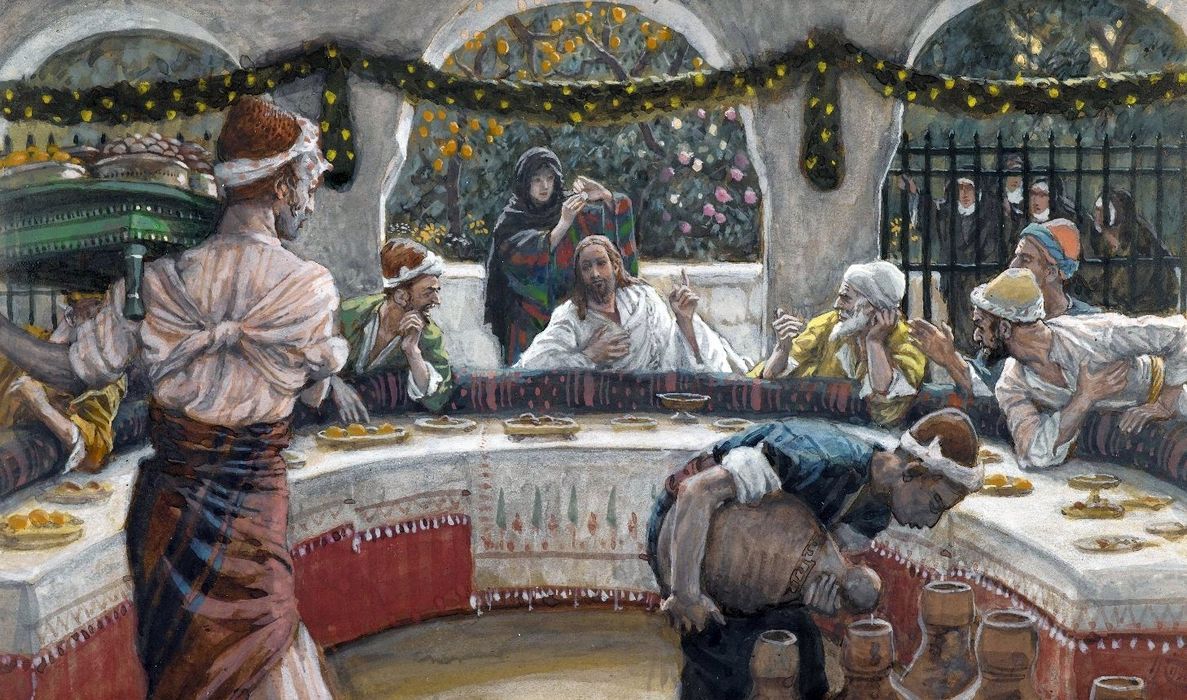
Reading time: 5 min.
“The Meal in the House of the Pharisee” , James Jacques Joseph Tissot (b. Nantes, France, 1836–1902), 1886-1894, watercolor, Brooklyn Museum in New York
This passage from Luke’s Gospel, chapter 11:37-41, tells us how Jesus, on his way to Jerusalem, accepts a Pharisee’s invitation to dine with him. We witness a dialogue that represents a confrontation between two visions of religiosity: the formal one, centred on ritual prescriptions, and the one of the heart, proposed by Jesus.
In response to the question put to Jesus about why he does not follow the ritual gestures of tradition, the Pharisee is invited to go beyond outward actions, to check whether the exterior truly corresponds with what he carries in his heart.
Jesus accepts the invitation unconditionally
Like the Pharisee, we too can invite Jesus to our table. His response is astonishing: Jesus always accepts, without setting any conditions. He does not demand that our house be in order, nor does he require guarantees of our integrity. “He went in and sat down at the table” – with this disarming simplicity, Jesus enters the Pharisee’s life, already knowing what he will find, aware of the contradictions, the shadows, the duplicity.
This is the first liberating message. Jesus does not wait for us to be perfect to come to us; he comes to help us put ourselves right. We do not have to hide who we really are to be worthy of his presence. On the contrary, it is precisely our incompleteness that makes us need to encounter him.
A presence that brings clarity
But be warned: although Jesus accepts unconditionally, his presence is never neutral or harmless. Jesus enters and brings light. The Pharisee was perhaps expecting a compliant guest, someone to show off, to display to his acquaintances. “Look, even Jesus comes to my house.” Instead, he finds himself laid bare without being humiliated or embarrassed. The presence of Jesus illuminates contradictions, bringing to the surface what we would rather keep hidden.
It is not an attack; rather, it is like when we switch on the light in a room. The light does not create the dust that is there, but it makes it visible. So, it is with Jesus. He does not invent our flaws, but gently and gradually helps us to see them for what they are. In short, his presence is an invitation to bring clarity into our lives; to look honestly at where we are authentic and where we live behind masks; where there is integrity and where there is a split between what we appear to be and what we are.
Beyond appearances: the call to personal integrity
“You Pharisees clean the outside of the cup and dish, but inside you are full of greed and wickedness.” Jesus does not condemn outward practices in themselves – the ablutions, the public prayers, the observances – but he shines a light on that subtle and terrible split between the outside and the inside, the duplicity of those who tend to their image while neglecting their heart.
It is a temptation that runs through all ages. How much energy we spend building an acceptable image! On social media, in our professional lives, even in our most intimate relationships. We filter, we select, we show only what enhances us. Jesus, instead, calls for integrity on a very personal level, even before a public one. It is not about what others see, but about who we really are when no one is watching. It is there, in the intimacy of the heart, that our authenticity is at stake.
A vision with no grey areas
“You fools! Did not the one who made the outside make the inside also?” There is a profound human and spiritual insight here: the human being is one. We are not divided into watertight compartments – the public and the private dimension, the body and the spirit, the exterior and the interior. We cannot keep grey areas, parts of our lives shielded from the light, thinking they will not contaminate the rest.
Jesus’s invitation is to a vision with no grey areas; a life in which there are no hidden corners where we cultivate vices, selfishness, duplicity. An inner transparency where everything is brought into the light of conscience and grace. This does not mean immediate perfection, but radical honesty, acknowledging our frailties, calling them by name, not justifying or hiding them. It is the first step towards healing.
Almsgiving as a gift of self
“But give what is inside as alms, and then everything will be clean for you.” Here lies the culmination of Jesus’s message. True purification comes not from outward rituals, but from the gift of what is inside. Integrity has the capacity to be a bearer of goodness. The word “alms” in Greek has its roots in the word “mercy,” compassion. It is not just a matter of giving money, but of giving ourselves: our time, our attention, our presence, our vulnerability.
When we live this inner unity, when there is no longer a split between who we are and who we appear to be, then from this unity emanates true almsgiving, authentic mercy: a genuine gift, not calculated, not instrumental. We do not give to appear generous, but because generosity has become who we are.
The thirst of the young for authentic and consistent adults
This message has a particular resonance today, especially for the new generations. Young people are immersed in a culture where everything has a price, everything is calculated in terms of performance and utility. Identities are fragmented among a thousand profiles, masks, social roles; relationships are mediated, filtered, often anonymous or superficial.
In this context, young people have a desperate thirst for authentic adults; people who live what they say, who do not have one face for the public and another for private, who do not lie for convenience.
We must never forget that young people are not looking for perfect adults – they reject them as false. They are looking for real adults: capable of acknowledging their own frailties, of being consistent in the small things of daily life, of keeping their word, of having an inner life that shows. The greatest service we can render to the new generations is not to give them moral advice or rules of behaviour, but to bear witness to an authentic life.
The permanent invitation
The Pharisee invited Jesus once. But the text reveals to us that Jesus is always available to be invited, today as he was two thousand years ago.
The question for each of us is, are we willing to welcome him, knowing that his presence will confront us with the truth of ourselves? Are we ready to let him shine a light into our grey areas? And then, after having welcomed this light, are we willing to live in authenticity, giving up our masks, giving to others not what we have left over but “what is inside”?
In a world thirsty for truth, being authentic people is not a spiritual luxury; it is the first act of charity we can perform. Especially towards those who, like the young, have the right to see that it is possible to live without duplicity, that integrity is not a utopia, that coherence between the inner and outer self is the path to true freedom.