


 By BSOL Editor
Reading time: 6 min.
Filipino Salesian Fr Ding tells the story of his missionary vocation and life at the Salesian mission in southern Argentina, among schools, parishes, and poor neighborhoods. From the Philippines to the outskirts of Buenos Aires
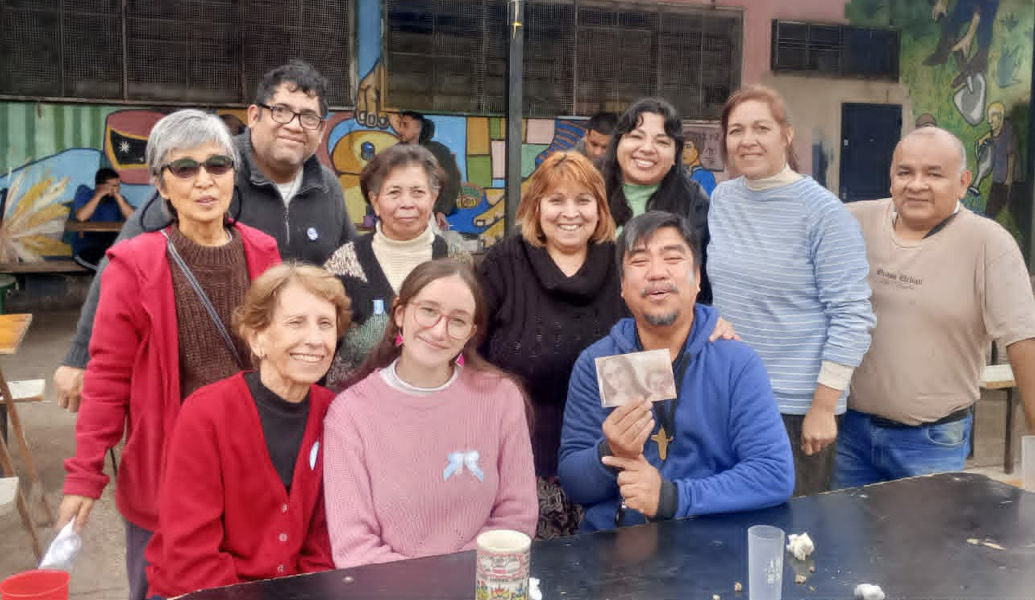
Since 1875, when the first expedition sent by Don Bosco arrived in Buenos Aires, Argentina has never stopped welcoming Salesian missionaries. At first, they were Italians; later, local vocations flourished, but even today there are those who leave their homeland to serve the young people of this Country. One such missionary is Fr. Jose Armando Cortez, known to everyone as “Ding”, a Filipino Salesian whom we met a few years ago, at the start of his missionary experience. Today, he looks back on his vocation, the three assignments that introduced him to different faces of the mission, and the challenges facing Salesians in Argentina.
The call at the oratory
I’m Fr. Jose Armando Cortez, but everyone calls me Ding. I come from the Philippines and am a missionary in Argentina. I’m currently based at Don Bosco Itatí, in the Argentina South Province, headquartered in Buenos Aires.
I discovered my vocation during the years I spent at the Don Bosco Oratory in the Philippines. I grew up alongside many Salesians who worked, played, and prayed with us boys every Saturday and Sunday. I heard the “call” in 1988, during the celebrations marking the centenary of Don Bosco’s death. With the support of the oratory director, Fr. John Cabrido, whom I greatly admire, and the assistant at the time, Manuel Domingo, now a priest, I decided to try entering the seminary. The rest is history.
What attracted me most was the Salesians’ constant presence and their commitment to helping my companions and me grow and mature as people. We were always busy and happy at the oratory: it felt like a family. That is what moved me to answer the call and follow the example of Don Bosco’s Salesians.
Tears in Papua New Guinea
I began to reflect seriously on a missionary vocation when I attended the episcopal ordination of Salesian Bishop Peter Baquero in Papua New Guinea. I had just been appointed Provincial Delegate for Missionary Animation, and was representing the Provincial. I don’t know what happened, but when people began singing in Tok Pisin (a pidgin language), a language I couldn’t understand, tears came to my eyes and didn’t stop throughout the celebration. It was as if God were saying to me: “I am here, I am here.”
I prayed for a long time, discussed it with my spiritual director, and sought advice from some confreres and friends. The discernment took four years. In the end, I wrote to the Rector Major and, by God’s grace, my request was accepted.
Setting off without choosing the destination
Fr. Václav Klement, who served as General Councilor for the Missions, had explained to me that anyone asking to leave on mission should not name their preferred country in the letter: the choice belongs to the Rector Major. I followed his advice. After waiting for a few weeks, Fr. Alfred Maravilla, then General Councilor for the Missions, told me that the Rector Major was sending me to Patagonia, Argentina.
I entrusted the discernment about my destination to my superiors with complete confidence. I know one thing: God is asking me to give him a little more of my life. As for where, I leave that to his grace.
Preparation and the language barrier
My preparation for the missions consisted only of the four years I spent as Provincial Delegate for Missionary Animation, and the course for new missionaries in Italy, which was shorter than usual because of the pandemic. This preparation could be enriched by spending about a year in the destination country beforehand, getting to know the confreres, the culture, and the context at first hand, rather than relying solely on the course’s theoretical lessons. I know the Missions Sector is considering this and working towards it. Language, in particular, is crucial. It can determine whether a missionary succeeds or fails. More time and greater immersion in the language and culture before departure would be a great help.
Three assignments, three faces of the mission
In Argentina, I’ve had three assignments, which have introduced me to three different realities. In La Boca, Buenos Aires, I was mainly involved in the school apostolate, and to some extent in parish life. It was my first assignment: a formative period, immersed in the life of the capital, and also a time to get used to the climate, the food, and the way things are done.
In Villa Regina, in Río Negro Province, Patagonia, I discovered parish life and a culture different from that of urban Buenos Aires. There I learnt a great deal about how to deal with situations and work with people.
Now, at Don Bosco Itatí, we work mainly with the poor in the villas, the informal settlements on the outskirts. Little by little, I’m getting to know the harsher realities: poverty, drugs, and the difficult circumstances of those living on the margins of the city, which affect young people so deeply.
Parish priest after three years
Last year was demanding. Although I had been in Argentina for only three years and could barely express myself in Spanish, I was appointed parish priest. The biggest difficulty was communication. It seemed too soon to entrust a new missionary with a leadership role.
Lights and shadows
The Argentina South Province (ARS) is full of life: the confreres are tireless and present in most of our works, they live very simply, and there is a strong sense of community life. The downside is that there are few vocations to consecrated Salesian life. I get the impression that we Salesians don’t speak explicitly enough about the Salesian vocation to the young people we serve with such dedication, creativity, and joy.
The Country is going through a profound crisis. The economy is in serious difficulty, and this weighs on everyone: the worries and hardships of the poor also find their way into our conversations and prayers.
Another reality that struck me is the extent of secularization. When I taught catechism to students in the third year of secondary school in Villa Regina, I was surprised by how many said they were atheists or did not believe. Many young people stay outside the church walls, yet are happy to take part in religious activities. Most people say they are Catholic or believers, but do not practice their faith.
Hospitality and differences
The Argentine Salesians are very welcoming: the only real obstacle to missionaries’ integration is the language. Some difficulties have arisen because of differences in personality, but in general I’ve felt well treated and supported. The local people have welcomed me too, though to varying degrees depending on the place. The culture in Buenos Aires is more open, thanks to the great variety of people and cultures in the city; Patagonia is a little less open, perhaps because of its sparse population and the concentration of certain ethnic groups in particular provinces. Outside the city, people also seem to me to be more religious and more attached to tradition.
Reflecting on the experience together
This year I had the privilege of taking part in a formation meeting in Montevideo, Uruguay, for Salesian missionaries sent to the American continent in recent years. Meeting younger confreres made me appreciate the generosity of Salesians around the world. I understand their difficulties with the culture and language very well, because I went through them myself in my early years.
I took advantage of the moments of silence and personal prayer to reflect on my experience, with its bright spots and struggles. I also tried to share it with the other missionaries, so they might gain something from it, and listened to their stories, which were a source of inspiration to me.
I remember that in my third year I was able to attend the course on inculturation run by the Claretians in Córdoba. It was a profound spiritual encounter for me: it gave me space to share and process my experience – in English too – with missionaries from other congregations. I learnt about Argentina’s different realities and cultures, and this helped me make sense of what I was experiencing in Buenos Aires and Río Negro. In Montevideo, I saw the same effect on the new missionaries, who were able to express the challenges they faced in relation to the culture, life with their confreres, and their own inner struggles. We were given a space to share what we carry inside and work through it calmly, in prayer and fraternity.
Tomorrow’s challenges
In my view, growing secularization and artificial intelligence are the challenges facing Salesian missionaries in Argentina and, I believe, throughout the world. It will be no less challenging to inspire young people, and even our confreres, to want to become missionaries.
To all the readers of the Salesian Bulletin Online: thank you for the time you devote to following our journeys of faith as we answer the call to mission each day! May your hearts, too, be open to God’s call to be missionaries in your own way, and may your lives be a journey that leads you to serve others, especially the poor, and to encounter the God who loves us with an everlasting love. May God always bless you!
Marco Fulgaro
 P. Fabio ATTARD
 P. Natale CERRATO