


 By BSOL Editor
Reading time: 10 min.
Anyone leaving on a long journey knows that packing a suitcase is an examination of conscience. One must choose, and in choosing, one declares what is considered truly indispensable. In the summer of 1875, while preparing the departure of his first ten missionaries for Argentina, Don Bosco did exactly this exercise, but in writing, item by item, with the price alongside.
The document is preserved in the Biographical Memoirs (XI, 559-560) and bears a dry title: Kit of the principal things required by the Salesian religious who at the end of next October will have to travel to the Argentine Republic. It is an estimate: chalices, chasubles, shirts, socks, a harmonium, a piano. Total 26,355 francs, of which 4,000 for half the journey – the other half, a marginal note records, is paid by the Municipality of San Nicolás.
Amidst the objects of worship and the linen, there is a long list of books. And it is there that the document ceases to be a list of expenses and becomes a portrait.
A warehouse, not a library
The first thing that strikes you is not the titles: it is the numbers.
«Our anon. booklets» – 1000 copies
The Companion of Youth – 500 (+ 50 finely bound) copies
The Key to Paradise – 500 (+ 50 finely bound) copies
Sacred History – 150 copies
Ecclesiastical History – 50 copies
The Instructed Catholic – 50 copies
The Provided Catholic – 25 copies
History of Italy – 25 copies
Scavini, Theologia moralis – 10 copies
Perrone, Theologia dogmatica – 10 copies
Liguori, Works – 5 copies
Segneri, Works – 5 copies
Da Ponte, Meditations – 5 copies
Rodríguez, Exercise of Perfection – 5 copies
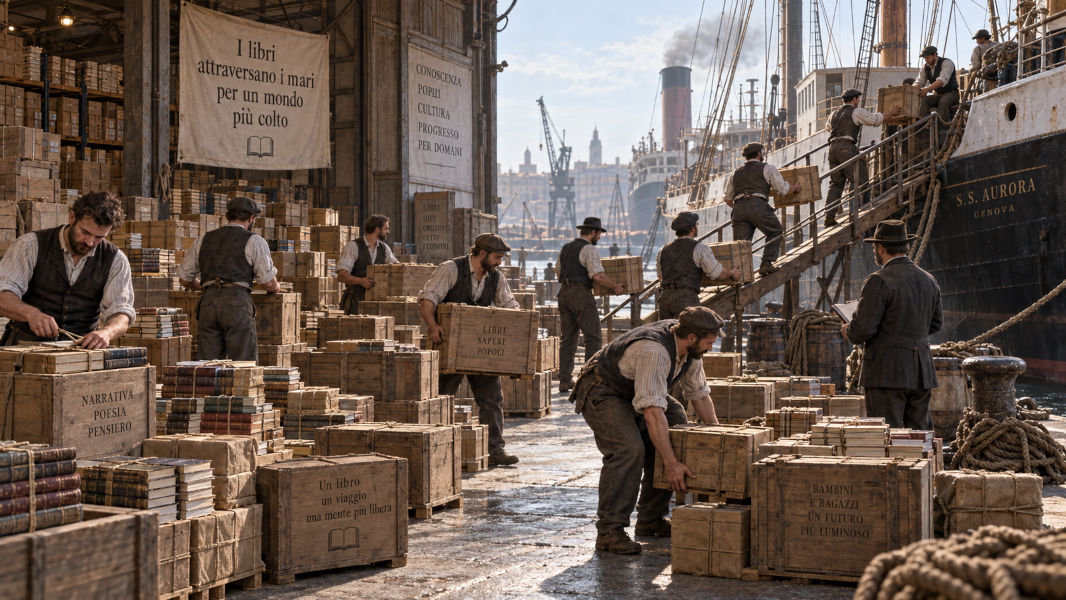
Over two thousand volumes for ten people. The missionaries take with them many more books to give away than shirts to wear. It is not a library: it is a travelling warehouse. For Don Bosco, the dissemination of the good press is not a polite corollary of the charism – it is merchandise that is loaded first, along with the chalices.
Three concentric circles
The print runs, read carefully, draw an entire pastoral programme on their own.
The first circle is the people.
A thousand anonymous booklets, five hundred Companion of Youth, five hundred Key to Paradise: tiny, cheap, practical pamphlets. They do not explain the faith; they make it practised. They are destined to pass from hand to hand among the Italian emigrants of Buenos Aires, to be left in a house, slipped into a pocket.
The second circle is the school.
Sacred History, Ecclesiastical History, The Instructed Catholic, The Provided Catholic, History of Italy: from 150 to 25 copies. These are not gift quantities, they are classroom quantities. It is the equipment of a boarding school that must open and truly function, with full desks. Here too, it should be noted, theory is almost absent: virtue is taught by telling stories, faith through lived history.
The third circle is the community.
Scavini for morals, Perrone for dogmatics: ten copies each, that is one each. Not in common, not for the house library, one for each missionary. And then, five copies at a time, Liguori and Segneri for preaching, da Ponte and Rodríguez for meditation.
A missionary project codified in numbers of copies.
The foreseen loneliness
The small library of the confreres deserves a pause. The titles have nothing surprising about them: Scavini and Perrone were the standard manuals of any Piedmontese seminary of those years. Nothing original, nothing specifically Salesian, nothing specifically missionary.
The significant decision does not lie in the choice; it lies in the quantity. Ten personal copies mean that each one will have to study alone, resolve cases of conscience in the confessional alone, prepare sermons alone – without a library, without a professor, without an elderly confrere to ask. Don Bosco is packing the intellectual loneliness that his sons will encounter, and tries to make it habitable.
Why it was possible
The prices tell the second half of the story. An anonymous booklet
costs 15 cents; a Key to Paradise, 30; a Sacred History,
- A volume by Liguori costs 50, a Scavini 20 francs.
A single Liguori is worth more than three hundred booklets.
What Don Bosco prints is almost free; what he has to buy on the market is very expensive. The apostolate of the press on this scale is sustainable for a very concrete reason: Don Bosco is his own publisher. The Valdocco printing press is not an appendage of the Oratory, it is what makes the mission possible.
Where the splendour lies
There is, however, a reversal that is worth looking in the face. All the non-liturgical books put together are worth about two thousand francs out of twenty-six thousand. Harmonium and piano, alone, make up one thousand six hundred – and alongside them appear methods for plainchant, for vocal music, for organ, «various pieces». With Fr. Cagliero at the head of the expedition, it is not surprising, but it must be said: music weighs as much as the press. And then there is the church. Vestments, sacred vessels, and furnishings exceed eight thousand francs: five chalices, sixteen chasubles for all liturgical colours, a thousand francs of candlesticks, four lamps, two lectern antiphonaries. In the wardrobe and in the library, Don Bosco is of an almost severe parsimony; before the altar he becomes generous to the point of abundance. To the poor of Buenos Aires one can give a fifteen-cent booklet, but the liturgy is celebrated with full dignity.
Fifty finely bound copies
A very small, and very beautiful detail. Of the five hundred copies of the Companion of Youth and the five hundred of the Key to Paradise, fifty and fifty are ‘finely bound’.
They are the presentation copies: for Archbishop Aneiros, for the municipal commission of San Nicolás, for the benefactors yet to be won over. Don Bosco also budgets for the diplomacy of the foundation. He knows that a new house, in an unknown land, rests on relationships before resources.
And finally, at the bottom of the list, three paintings: Mary Help of Christians, Saint Francis de Sales, Saint Aloysius. Three hundred francs. It is the iconographic programme of Valdocco exported intact – the visual equivalent of the choice of books.
A house to be reassembled elsewhere
Something is missing from this list, and the absence is as instructive as the presences: there is no dictionary, there is no Spanish grammar, there is no book on Argentina or on the populations of Patagonia. Nothing exotic, nothing ‘missionary’ in the sense that the word would later assume.
Because the list does not describe a mission: it describes a Salesian house to be dismantled in Turin and reassembled ten thousand kilometres away. The same books, the same saints on the walls, the same music, the same way of making the boys pray. A hundred and fifty years later, that choice appears as the very reason for the success. Don Bosco did not send his sons to improvise: he sent them an already tested method, and the confidence that the method would work even on the other side of the world, provided it remained recognisable. In the trunks embarked in Genoa on 14 November 1875, there was no generic idea of apostolate. There was Valdocco, in two thousand volumes, ready to be opened.
Let us identify these books presented above in the editions closest chronologically and most likely available at Valdocco in 1875; in some cases, the abbreviated title allows a certain identification, in others only a probable one.
- WORKS BY DON BOSCO AND THE ORATORY PRINTING PRESS
- Companion of Youth – 500 + 50 copies
BOSCO, Giovanni, Il giovane provveduto per la pratica de’ suoi doveri negli esercizi di cristiana pietà, per la recita dell’Uffizio della B. Vergine, dei Vespri di tutto l’anno e dell’Uffizio dei morti, coll’aggiunta di una scelta di laudi sacre, 42nd edition, Turin, Tipografia e Libreria dell’Oratorio di S. Francesco di Sales, 1875.
- Key to Paradise – 500 + 50 copies
BOSCO, Giovanni, La chiave del paradiso in mano al cattolico che pratica i doveri di buon cristiano, 36th edition, Turin, Tipografia e Libreria dell’Oratorio di S. Francesco di Sales, 1875, 207 pp.; 73 × 108 mm.
- Instructed Catholic – 50 copies
BOSCO, Giovanni, Il cattolico istruito nella sua religione. Trattenimenti di un padre di famiglia co’ suoi figliuoli secondo i bisogni del tempo, epilogati dal sacerdote Bosco Giovanni, Turin, Tipografia diretta da Pietro De-Agostini, 1853, 340 pp.; approx. 85 × 135 mm.
The work had originally been published in several fascicles of the Catholic Readings, year I, and then gathered into a volume.
- The Provided Catholic – 25 copies
BOSCO, Giovanni, Il cattolico provveduto per le pratiche di pietà con analoghe istruzioni secondo il bisogno dei tempi, Turin, Tipografia dell’Oratorio di S. Francesco di Sales, 1868, VIII, 765, [3] pp.; approx. 105 × 154 mm.
- Little Ecclesiastical History – 50 copies
BOSCO, Giovanni, Storia Ecclesiastica ad uso della gioventù utile ad ogni grado di persone, 4th improved edition, Turin, Tipografia dell’Oratorio di S. Francesco di Sales, 1871, 464 pp.; approx. 90 × 140 mm.
The adjective ‘little’ seems to be a practical qualification used in the estimate to distinguish it from larger ecclesiastical manuals, not part of the publishing title.
- History of Italy – 25 copies
BOSCO, Giovanni, La storia d’Italia raccontata alla gioventù dai suoi primi abitatori sino ai nostri giorni, con analoga carta geografica, Turin, Tipografia e Libreria dell’Oratorio di S. Francesco di Sales, 9th edition, 1873, 558 pp.; approx. 125 × 190 mm; or the copies indicated as 10th edition, 1874.
- Little Sacred History – 150 copies
BOSCO, Giovanni, Maniera facile per imparare la storia sacra ad uso del popolo cristiano, con una carta geografica della Terra Santa, 3rd edition, Turin, Tipografia dell’Oratorio di S. Francesco di Sales, 1863, 106, [2] pp.; approx. 86 × 135 mm, with geographical map.
- Our anon. booklets – 1000 copies
This entry does not designate a single work. «Anon.» should probably be expanded to «anonymous»: it would be a thousand cheap, devotional, apologetic or catechetical pamphlets, printed or distributed by the Oratory without indication of the author.
Identification with a particular series, such as the Catholic Readings, would be possible only as a hypothesis, but should not be taken for certain.
- THEOLOGY MANUALS
- «Theologia Moralis, Scavini» – 10 copies
SCAVINI, Pietro, Theologia moralis universa ad mentem S. Alphonsi Mariae de Ligorio, episcopi et doctoris, Pio IX Pontifici Maximo dicata, 12th edition, Mediolani, apud Ernestum Oliva, 1874, 4 volumes.
- «Theologia dogm. by Fr. Perrone» – 10 copies
PERRONE, Giovanni, S.I., Praelectiones theologicae, quas in Collegio Romano Societatis Iesu habebat Ioannes Perrone e Societate Iesu, 31st highly emended edition, Taurini, ex officina stereotipographica Hyacinthi Marietti, 1865, 9 volumes gathered in 4 tomes; approx. 22 cm.
III. BOOKS FOR PREACHING
- «Liguori, Works etc.» – 5 copies
It is not possible to identify a single edition. The entry probably indicates a collection of the works of Saint Alphonsus Maria de’ Liguori, or a selection of volumes particularly useful to preachers and missionaries.
LIGUORI, Alfonso Maria de’, Selva di materie predicabili ed istruttive, per dare gli esercizi ai preti ed anche per uso di lezione privata a proprio profitto, con una piena istruzione pratica sugli esercizi di missione.
LIGUORI, Alfonso Maria de’, Discorsi sacri morali, ossia sermoni compendiati per tutte le domeniche dell’anno.
These texts are also found included in the collections entitled Ascetical Works or Complete Works of Saint Alphonsus Maria de’ Liguori. Since the entry is placed under the heading «Preaching», the Selva di materie predicabili and the Discorsi sacri morali are the most relevant identifications, but not exclusive ones.
- «Segneri, works» – 5 copies
The entry refers to a collection of the works of the Jesuit Paolo Segneri, without indication of the edition. The most relevant publications for preaching are:
SEGNERI, Paolo, S.I., Quaresimale del padre Paolo Segneri della Compagnia di Gesù, Turin, Giacinto Marietti, 1869.
SEGNERI, Paolo, S.I., Il cristiano istruito nella sua legge. Ragionamenti morali, Turin, Giacinto Marietti, 1869.
In the collections of the Works there may also appear:
– La manna dell’anima;
– L’incredulo senza scusa;
– Panegirici sacri;
– Prediche dette nel Palazzo Apostolico.
- ASCETICAL BOOKS
- «Da Ponte» – 5 copies
This is the Spanish Jesuit Luis de la Puente, Italianised as Lodovico da Ponte. The work almost certainly indicated is:
PUENTE, Luis de la, Meditazioni del venerabile padre Lodovico da Ponte della Compagnia di Gesù sopra i principali misteri della nostra fede, della vita e passione di Nostro Signore Gesù Cristo e della Beatissima Vergine Maria, con la pratica dell’orazione mentale, divise in sei parti, Italian translation by Giulio Cesare Braccini, Turin, Giacinto Marietti, multiple volumes.
- «Rodriguez» – 5 copies
RODRÍGUEZ, Alonso, S.I., Esercizio di perfezione e di virtù cristiane, divided into three parts, Turin, Giacinto Marietti, in multiple volumes.
The third part may present itself with the autonomous title: Esercizio di perfezione e di virtù religiose.
Don Bosco used stereotyped Turinese Marietti editions; documented, for example, is the edition: RODRÍGUEZ, Alonso, Esercizio di perfezione e di virtù cristiane, vol. III: Esercizio di perfezione e di virtù religiose, Turin, Giacinto Marietti, 1828.
- LITURGICAL AND MUSICAL BOOKS
- Missals – 8 copies
Missale Romanum ex decreto Sacrosancti Concilii Tridentini restitutum, S. Pii V Pontificis Maximi jussu editum, Clementis VIII et Urbani VIII auctoritate recognitum. Accuratissima editio cum additamentis novissimis, Taurini, apud Petrum H. F. Marietti, Typographum Pontificium, 1872.
- Folders for Requiem masses – 8 copies
Missae pro defunctis ad commodiorem ecclesiarum usum ex Missali Romano desumptae. Accedit ritus absolutionis post Missam pro defunctis ex Rituali et Pontificali Romano, [Taurini, liturgical printing press, ante 1875].
The word cartella does not indicate here a folder of loose sheets, but an autonomous liturgical volume, generally in large format and printed in red and black, containing the masses for the dead and the rite of absolution at the coffin or tomb. The Salesian catalogue also explicitly calls it «Messale da morto».
The price was 60 francs for eight copies, that is 7.50 francs each: it was therefore not a simple cheap pamphlet, but likely a well-bound altar volume.
- Folders for benediction – 3 copies
Orationes in Benedictione SS. Sacramenti pro opportunitate temporum, litaniae ac preces in Oratione XL Horarum et pro in agone laborantibus, Taurini, liturgical printing press.
In other reprints the title appears in the form:
The “folder” presumably contained:
– hymns and versicles for Eucharistic exposition and benediction;
– Tantum ergo and related orations;
– litanies;
– prayers for the Forty Hours;
– formulas for particular solemnities and necessities;
– prayers for the dying.
The total price of 20 francs for three copies, about 6.67 francs each, suggests also in this case bound altar volumes and not simple sheets.
- Breviaries
– 12 copies
Breviarium Romanum ex decreto Sacrosancti Concilii Tridentini restitutum, S. Pii V Pontificis Maximi jussu editum, Clementis VIII et Urbani VIII auctoritate recognitum, cum officiis sanctorum novissime concessis.
The sum of 150 francs is equivalent to 12.50 francs per copy. The wording «12 copies» most probably suggests twelve complete breviaries intended for priests and clerics, not twelve single tomes of an incomplete series.
- Antiphonaries – 2 copies
Antiphonarium Romanum de tempore et sanctis ad normam Breviarii ex decreto Sacrosancti Concilii Tridentini restituti, S. Pii V Pontificis Maximi jussu editi, Clementis VIII et Urbani VIII auctoritate recogniti.
The cost of 80 francs per copy, clearly higher than that of all the other liturgical books, almost certainly indicates large volumes, with musical notation, intended for the lectern of the choir or the church.
- Horae diurnae – 20 copies
Horae diurnae Breviarii Romani ex decreto SS. Concilii Tridentini restituti, S. Pii V Pontificis Maximi jussu editi, Clementis VIII et Urbani VIII auctoritate recogniti, cum officiis sanctorum novissime per Summos Pontifices usque ad hanc diem concessis, Taurini, ex Typographia Pontificia et Archiepiscopali Equitis Petri Marietti, 1875, 606 pp.
The Horae diurnae contained the daytime hours of the Office – Lauds, Prime, Terce, Sext, None, Vespers and Compline – omitting Matins. The cost was only 3 francs per copy, consistent with a compact volume intended for clerics, priests on the move or other members of the expedition.
- «Methods for plainchant, for vocal music, for organ, various pieces» – 150 copies
This is a category of material, not the title of a single book. It likely included:
– didactic methods of plainchant or Gregorian chant;
– manuals and exercises for choral singing;
– methods for organ or harmonium;
– loose sheet music and sacred compositions.
In 1882 Giovanni CAGLIERO published his Metodo teorico-pratico del canto fermo, corredato di dodici lezioni preparatorie facili e progressive…, Turin, Tipografia dell’Oratorio di S. Francesco di Sales, 1882.
It is possible that in 1875, manuscript materials or preliminary forms used by Cagliero and the masters of Valdocco were circulating. The wording ‘various pieces’ almost certainly indicates loose sheet music, not bibliographic monographs.
 P. Fabio ATTARD
 P. Natale CERRATO