

 By Fr Bruno FERRERO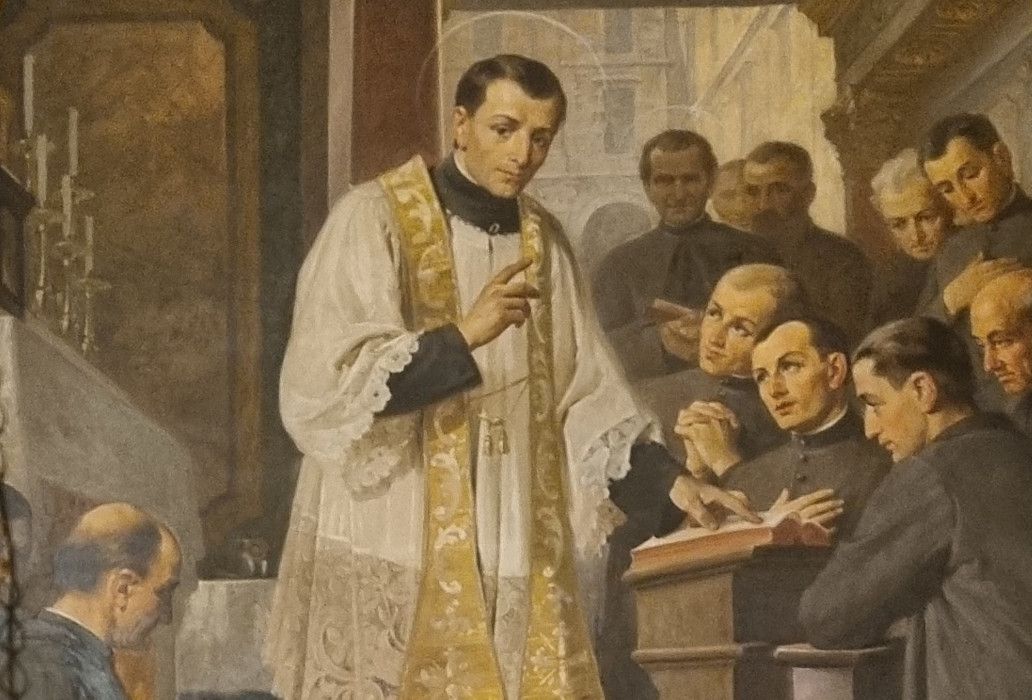
Reading time: 4 min.
Saint Joseph Cafasso, Piero Dalle Ceste (1938), above the altar dedicated to him in the Basilica of Mary Help of Christians, Turin-Valdocco.
Saint Joseph Cafasso was a Piedmontese priest, moral theologian and great spiritual director, distinguishing himself for his formation, profound charity, and intense ministry, especially in prisons. An esteemed educator at the Ecclesiastical College of Turin, he was the teacher of numerous priests and a point of reference for the Turin clergy. Central is his relationship with Don Bosco, for whom he was a decisive guide in vocational choices and a concrete supporter of the nascent Oratory, also on an economic and institutional level. Fr. Cafasso accompanied Don Bosco throughout his life, fostering his educational work. He died in 1860, leaving part of his assets to the Oratory, whose memory Don Bosco publicly honoured.
Because he knew how to listen.
Joseph Cafasso, moral theologian, preacher, and spiritual director, was born in Piedmont in Castelnuovo d’Asti (now Castelnuovo Don Bosco), on 15 January 1811, to Giovanni and Orsola Beltramo, the third of four children. The family, of peasant origin, lived in decent economic conditions. The parents were exemplary, the mother extremely religious. From a young age, Joseph proved to be obedient, devout, fond of religion, faithful to the catechism, charitable towards the poor, willing and brilliant at school.
In the school year 1823-24, with other boys from Castelnuovo, he moved to Chieri to attend the upper Latin school. For three years, he lodged in the house of the tailor Tommaso Cumino. During this period, he had the opportunity to frequent the Marian congregation at the Jesuits’ church of Sant’Antonio Abate, where he was initially reprimanded for not having been definitively admitted to holy communion, believing that this was due to his negligence in catechism; but he was immediately admitted.
At first, he was the object of mockery and mistreatment by some tactless companions, but later he gained respect and moral ascendancy among the students for his goodness and diligence in his studies.
In the meantime, the seminary was inaugurated in Chieri, where he was accepted in November 1829, for the final three years of theological studies (1830-1833).
It was probably in the summer of 1830 that John Bosco met the seminarian Cafasso in front of the chapel of St. Peter in Morialdo, on the occasion of a local festival. Always in precarious health, Joseph Cafasso “excelled only in study and virtue”. He lived according to two principles: “Holiness does not consist in doing extraordinary things, but in doing ordinary things in an extraordinary way”; “Ask for nothing and refuse nothing”.
He moved to the Ecclesiastical College and almost immediately Fr. Cafasso was put in charge of the group that taught the Lenten catechism in the prisons. The ministry in the prisons, with the religious instruction and spiritual care of the prisoners, remained his favourite activity for the rest of his years.
On 27 June 1836, Cafasso passed the final exams brilliantly and the theologian Guala, with the unanimous support of the teaching staff, proposed that he remain as a tutor at the College.
Thus, upon Guala’s death, Fr. Cafasso assumed the office of rector.
It is worth noting that the years 1844-1848 (when Fr. Cafasso gradually took over the leadership of the Institute) were those in which Don Bosco, first stayed at the Rifugio as chaplain of the Ospedaletto Barolo, then moved to the Pinardi house, moving from catechism and Sunday recreational activities with poor young people to a more structured and stable pastoral and educational institution, the Oratory of St Francis de Sales. During those crucial years, Fr. Cafasso’s support was decisive.
In the Memoirs of the Oratory, Don Bosco, referring to the activities promoted by the theologian Guala, Fr. Cafasso and Fr. Golzio, writes: “The prisons, the hospitals, the pulpits, the charitable institutions, the sick at home; the cities, the towns, and we can say the palaces of the great and the hovels of the poor experienced the salutary effects of the zeal of these three luminaries of the Turin clergy.” Fr. Cafasso’s charity knew no bounds.
Fr. Cafasso’s relationship with Don Bosco
Without a doubt, Don Bosco must be considered as one of Cafasso’s most important disciples, whom some witnesses at the beatification and canonisation processes present as “co-founder and first collaborator”, without whom “Don Bosco’s work would not exist”.
After the first meeting in Morialdo (around 1830), a bond was established between the seminarian Cafasso and the young Bosco, which became deeper over the years. It was a constant presence of advice, encouragement, and financial help throughout his formative journey. Cafasso, as has been mentioned, was decisive in Don Bosco’s vocational and ministerial choices. Lemoyne states that when he recommended him to the Marchioness Barolo for the chaplaincy of the Ospedaletto, he would have said to the theologian Borel, “Think a little if there is a way to keep him with some employment in this capital. It is absolutely necessary. Endowed as he is with activity and zeal, he will do great good for the youth. He is destined by Providence to become the Apostle of Turin.” When Don Bosco then left his employment with the Marchioness and moved to the Pinardi house, it was again Cafasso in collaboration with Borel who financially supported the Oratory and guaranteed the rent, loans, and purchases. He continued his support for the new buildings constructed in place of the Pinardi house in 1853 and 1856. For some years, Fr. Cafasso paid most of the bills for food and other needs of the Oratory. Then he recommended Don Bosco to charitable people and institutions in the city. Finally, he supported him with Archbishop Luigi Fransoni, the ecclesiastical and civil authorities, and the royal family.
Above all, Fr. Cafasso formed and spiritually guided Don Bosco through confession and the preaching of spiritual exercises.
The death of Fr. Cafasso
Fr. Cafasso died on 23 June 1860, at the age of 49. On 12 June 1860, he sat in the confessional for the last time, then he was struck by a severe lung infection which he could not overcome.
Don Bosco was prevented from visiting his beloved teacher in those last days, because it was thought that he wanted to extort money from him.
In his will, Fr. Cafasso allocated the largest part of his personal assets to the Little House of Divine Providence and included a clause in favour of Don Bosco and the Oratory. “I leave to the Priest D. Giovanni Bosco […] what is my property by site and building adjoining the Oratory of St. Francis di Sales in this Capital, Valdocco region, with the addition of five thousand lire as a one-off payment. I forgive him whatever he may be indebted to me at my decease, therefore tearing up or returning to him every record in this regard.”
On 10 July 1860, Don Bosco honoured his memory with a solemn mass and a funeral oration in the church of the Oratory. On 30 August, he was invited to give the official oration during the solemn commemoration in the church of St. Francis of Assisi.
Arthur J. Lenti, Don Bosco history and spirit, vol. I, p. 319
 BSOL Editor
 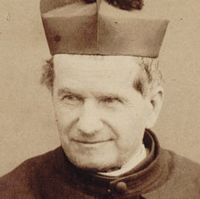 St John Bosco