


 By BSOL Editor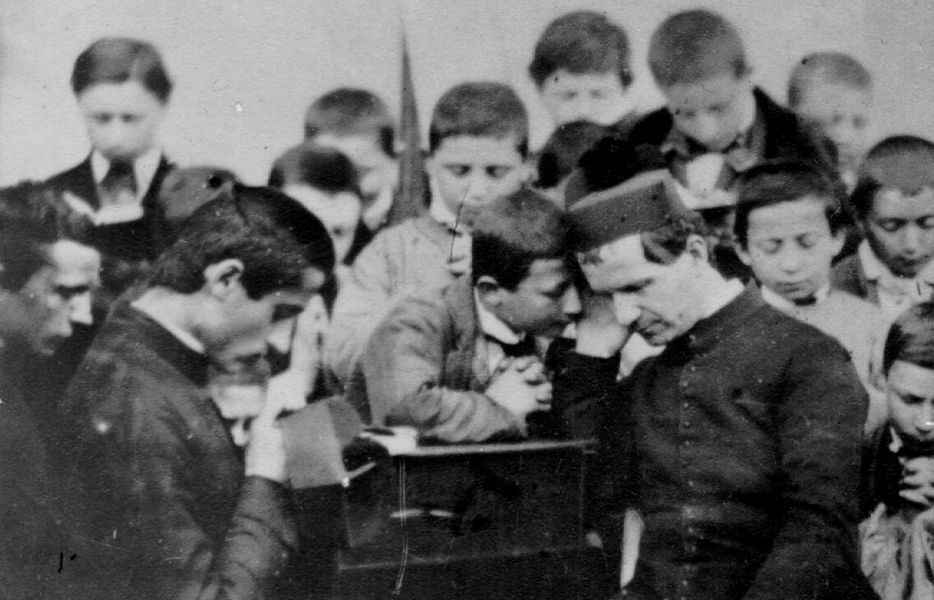
Reading time: 7 min.
Confession holds a central place in the life and mission of Saint John Bosco. For him, it was not merely one religious practice among others, but one of the privileged places where God’s mercy is made manifest and the human heart is renewed. Don Bosco invited people to confession with a disarming simplicity, with the gentleness of a father, and the passion of a true shepherd, able to reach young people, the poor, the estranged, and sinners in courtyards, squares, prisons, and churches. In his priestly experience, the sacrament of Reconciliation appears as a concrete path of hope, truth, and peace, offered to all with tireless kindness and that affectionate frankness which made his invitation to return to God credible.
A sacrament at the centre of everything
Anyone who knows the life of Saint John Bosco knows that one of the guiding threads of his priestly existence is the sacrament of Confession. Not a devotion among many, not just another pastoral duty. For Don Bosco, confession was the beating heart of the care of souls, the privileged place where God’s mercy reached the sinner and regenerated them. The Biographical Memoirs, the monumental nineteen-volume collection documenting his life, return to this theme with extraordinary frequency. The word “confession” appears almost a thousand times in those pages, testifying to how central the sacrament of Penance was to his existence and his educational and pastoral method.
For Don Bosco, hope, mercy, and confession were synonymous. This highly effective synthesis reveals the practical theology he lived: confession was not primarily a tribunal, but the wide-open door of divine mercy. Anyone who approached him with the weight of sin found in him, not a stern judge, but a father who rejoiced at seeing his child return home.
Countless hours in the confessional
As soon as he obtained his faculties for hearing confession on 10 June 1843, Don Bosco dedicated himself to this ministry with an intensity that astonished his contemporaries. His biographers note that when he arrived at the Refuge in Turin, where he carried out his first pastoral services, he was not yet in charge of preaching, but as soon as he was granted the faculty to hear confessions, almost everyone wanted to confess to him, and he listened to them all.
In the early days of the Oratory in Valdocco, Don Bosco would sit on a stool in a corner of the courtyard or chapel, and the boys would kneel around him to confess, while others prepared or made their thanksgiving. It was an unusual and moving sight. A priest sitting outdoors, surrounded by children patiently waiting their turn. On certain feast days, the crowd was so large that even a dozen priests would not have been enough; yet the boys all wanted to confess to him alone, and they had to be persuaded to postpone Communion until the following day.
As the Oratory and later the Hospice grew, the hours Don Bosco spent in the confessional became legendary. He would rise early in the morning and, even before leaving his room for the sacristy, he already knew that requests for confession awaited him. He himself had written in his resolutions of 1845: “Since, upon arriving in the sacristy, I am usually immediately asked to hear confessions, I will try to make a brief preparation for Holy Mass before leaving my room.” He heard confessions early in the morning, during recreation, and in the evening. He never missed an opportunity.
There was also a weekly rhythm for confessions at the Oratory. Every feast day morning, the young people were given the opportunity to approach the sacraments, but one Sunday a month was set for the general confession and communion of all. And in the rule written by Don Bosco, confession was prescribed at least every fifteen days, with the option to go every Saturday for those who wished.
The art of invitation: Don Bosco’s affectionate frankness
What distinguishes Don Bosco from so many other zealous priests is his extraordinary ability to invite people to confession without forcing them, to open the way to the sacrament with a touch of humour, simplicity, and disarming wit. The Biographical Memoirs dedicate an entire chapter of the third volume (chapter VII) to illustrating “the wonderful frankness of Don Bosco at Porta Nuova, in Piazza Castello, in Piazza d’Armi, and elsewhere in bringing sinners back to God.” For him, every place was suitable, every encounter an opportunity.
In taverns, inns, cafés, and barbers’ shops where he went to seek out abandoned boys, Don Bosco never lost sight of the ultimate goal, to lead that soul back to God. He would start with a joke, a magic trick, a story that captured their attention. Then, little by little, he would steer the conversation to a spiritual level, and almost without the other person noticing, they would find themselves listening to an invitation to confession. “Thus, the stubborn felt their resistance vanish, they welcomed the good resolutions that divine grace inspired in them, and little by little they were led to a good confession.”
With the boys of the Oratory, the method was even more direct and affectionate. He would approach a young man during recreation, put a hand on his shoulder, exchange a few cheerful words, and then, almost in passing, “So, when are you going to confession? It’s been a while since you’ve seen the confessor…”. The approach was so natural and free of judgement that the boys rarely refused. And the one who confessed first, returning happy and serene to the courtyard, unwittingly became the best ambassador; seeing his contentment, the others would pluck up the courage and follow him.
His way of approaching even adults who were most distant from religious practice was also famous. With a woman who had not been to confession for a long time, it was enough for him to gently utter the word “confession” for her to exclaim, “Confession! It’s been a very long time since I’ve been to confession.” The breach was made. With coachmen, with policemen, even with prisoners on death row in the senatorial prisons of Turin, where he went every week with Don Cafasso, Don Bosco found a way to approach them with gentleness, to win their trust, to slowly dispose their souls to conversion. He never gave up in the face of a refusal, he would try, wait, and return.
Also memorable is the episode of the policemen who guarded him during a period of great difficulty with the civil authorities. After his sermons, those guards, who had not been to confession for years, would approach him, moved, asking to be heard in confession. Don Bosco offered them this charity, “oh so willingly!”, so much so that, as the guards changed every Sunday, it can be said that almost all of them ended up going to confession and receiving communion.
His recommendations: sincerity, frequency, trust
Don Bosco did not limit himself to inviting people to confession; he taught it, explained it, and recommended it with precise and concrete criteria. The first and most fundamental teaching was on absolute sincerity. “First of all, I recommend you do all you can not to fall into sin, but if by misfortune you happen to commit one, never let the devil induce you to conceal it in confession.” This recommendation returns with impressive consistency in every context: in the evening ‘goodnight’ talks, in speeches to large gatherings, in personal conversations.
The fear of concealing sins out of shame was for him one of the most serious spiritual tragedies. He wrote with a hand that trembled, “As I write, my hand trembles thinking of the great number of Christians who go to eternal perdition only for having concealed or not sincerely disclosed certain sins in confession.” And to those who found themselves doubting the validity of some past confession, he made a heartfelt appeal, put your conscience right immediately, sincerely disclosing what weighs on you, as if you were at the point of death.
The second recommendation was frequency. Don Bosco established the first Sunday of each month as the day for general confession and communion at the Oratory, recommending that everyone approach the sacrament as if it were the last confession of their life. This awareness of the present moment, this spiritual urgency, was not melancholy but an intensity of life; every confession could be the last, therefore every confession had to be made with all one’s heart.
The third recommendation concerned the confessor and the relationship of trust with him. Don Bosco urged his boys to put into practice the advice received in confession, and he invited them to bring their friends along. “Try to bring one of your companions to listen to the word of God or to approach the sacrament of Confession.” Confession was not a private and individualistic matter; it had an impact on the community; it had the power to spread goodness.
As for confessors, Don Bosco had precise instructions. They should never treat penitents harshly nor be surprised by their ignorance or by the things disclosed in confession. Kindness, patience, and discretion were indispensable qualities. The confessor was bound by the absolute seal of confession. “Even if he were to lose his own life, he cannot tell anyone the slightest thing about what he has heard in confession.” This guarantee of absolute confidentiality was for Don Bosco an essential element for penitents to have the confidence to open up completely.
A living legacy
Looking at the whole of Don Bosco’s life, a portrait emerges of a priest who took seriously Christ’s words to his apostles, “Whose sins you forgive are forgiven them.” For him, this power was not a privilege to be jealously guarded, but a responsibility to be exercised with boundless generosity, in and out of the confessional, early in the morning and late at night, with children and with those condemned to death, in churches and in squares, wherever a soul needed to find peace with God.
Don Bosco had understood something simple and profound; that abandoned boys, the poor, and sinners did not need to be condemned, but to be loved; and that the greatest love a priest could offer was to accompany them to the mercy of God, through that sacrament which he had learned to love since childhood, when his mother Margaret had led him by the hand to church for his first confession.
Don Bosco’s invitation has lost none of its freshness. It resonates today with the same insistent gentleness with which he approached his boys in the Oratory courtyard, those he met on the street, the distant and the weary. It is an invitation addressed particularly to those who have long been away from this sacrament of health and peace. No one is too far from God to be unable to return home.
Following in his footsteps, we take up his appeal and make it our own. For those who wish to approach or re-approach Confession, perhaps after years of absence, perhaps with some fear or uncertainty about how to proceed, we have collected on THIS PAGE some practical and spiritual guidance, in the hope that it may help them to open themselves to God’s grace and receive His forgiveness. As Don Bosco reminded his boys; conceal nothing out of shame, trust in the kindness of the confessor, and return serene like one who has been embraced by the Father.
This resource will always be accessible from the Home Page, in a dedicated area.
 Fr Bruno FERRERO