


 By BSOL Editor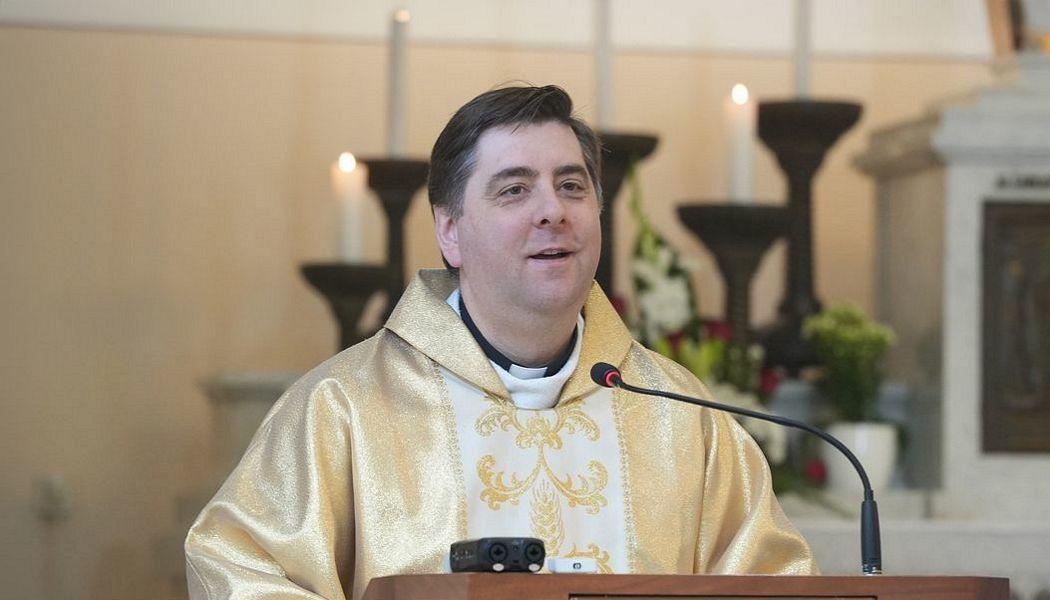
Reading time: 5 min.
We interviewed Fr. Gábor Vitális, the new superior of the Salesian Province of Hungary, about his vocational journey and his vision for the educational mission among young people. With candid authenticity, he recounts how the call to the priesthood gradually matured from his teenage years, amidst doubts and inner confirmations. Through his words, a picture rich in spiritual references emerges – from Don Bosco to St Dominic Savio – along with a contemporary reflection on the challenges of modern evangelisation. Fr. Vitális offers a sincere look at the joys and difficulties of educational service, stressing the importance of authenticity, prayer, and credible witness to reach the hearts of today’s youth.
What is the story of your vocation?
My vocation was not a sudden discovery, but the fruit of a long process of maturation. From childhood I was drawn to Christ and to closeness to the service of the altar. Around the age of twelve or thirteen, the idea of becoming a priest or religious first emerged in me, and this thought never left me. I also experienced struggles, a certain inner resistance. I also desired family life, but within me there was always the sense that God was calling me to something more.
After finishing secondary school, I enrolled at university, but I soon realized that I was not on the path God had planned for me. During that period, I began to pray consciously to recognize my vocation and to have the strength to say yes. In 2000, I entered the Salesian Institute, and since then I have been ever more deeply confirmed that this is where I belong.
Which people – saints, educators, family members – had the greatest influence on your vocational choice?
Many people had a decisive influence on me. My great-grandmother and an elderly teacher prayed for me for many years – today I am clearly aware of this. My mother took me to church and she herself resumed practicing the faith. The Salesians who lived in our city were an example to me through their love, their sense of humour, and their demanding and hardworking life.
Within the Congregation, among the former Provincials, Fr. Havasi had a significant role, as did many confreres. The person of Don Bosco and his pedagogy remain for me, even today, a point of reference and a compass. I remember well that I was a lively adolescent, but for years I carried in my pocket the motto of St. Dominic Savio, “Rather die than sin.” He was a true model for me, someone I wanted to follow, to become like him, strong in spirit, persevering in my duties, and at the same time able to remain always joyful.
What gives you the greatest joy in your service? And what is the greatest difficulty?
It is a great joy to see hope being born in young people and to see them experience that their lives are important, because God loves them. It is a joy to be able to be an instrument of God, whether in a simple service like offering breakfast or in a broader community initiative.
Difficulties spare neither our Province nor us, and it is not easy when one must make painful decisions or face crisis situations, especially when these touch the lives and trust of people. We cannot hide our heads in the sand or flee from problems; we must carry the inner burdens that all this entails. At the same time, however, we must recognize that such situations also offer an opportunity for purification and, through this, for spiritual growth.
How do you cultivate your ongoing formation – through books, courses, and spiritual exercises?
For me it is important to grow continuously not only on the professional level, but also on the spiritual one. My life is accompanied by numerous spiritual and theological readings, such as, for example, the writings of Fr. Pascual Chávez on the holiness of life, the writings of St. Augustine, and I continually read Don Bosco. I confess regularly, participate daily in Holy Mass and consciously encounter Christ in Holy Communion, and I consciously dedicate time to prayer.
In recent years, I have also studied canon law, which helps me make decisions in a responsible and transparent way.
In your opinion, what are today’s evangelical priorities for young people?
Today young people above all need authentic examples. Not theories, but people who live what they speak about. Faith must first be known, then witnessed, bearing witness to Christ with whom one has entered into a personal encounter. Words do not matter; authenticity does, because today’s young people need credible witnesses.
Naturally the community dimension is also important: feeling part of something, sensing that one is welcomed and recognized. The Gospel becomes understandable and attractive to them when it is conveyed with love, patience, and joy.
The spirituality of Don Bosco, the Preventive System, presence, and personal accompaniment remain today fundamental and fully relevant elements. However, all this truly reaches young people only if we ourselves are authentic and consistent with what we live.
How do you manage to reconcile prayer, study, and educational activity in daily life?
It is a continual search for balance. I do not wish to be only an active religious, but a religious who prays. When prayer is relegated to second place, the whole service risks becoming empty. At the same time, leadership tasks require a great deal of time, attention, and discernment.
I try to organize everything in such a way that these areas do not detract from one another, but rather strengthen each other.
What are today the greatest challenges of evangelization and mission?
One of the greatest challenges is the question of credibility. Young people are very sensitive to contradictions. When they perceive that the Church does not live coherently with its own teaching, this disorients them. It is equally fundamental to rebuild trust where it has been wounded.
The digital world and an accelerated lifestyle also represent a challenge. It is difficult to reach young people, and it is equally difficult to awaken in them the desire for a deep interior life.
What advice would you give to a young person who feels called to religious life?
I would tell him, do not be afraid of questions and struggles. They are a natural part of the vocational journey. Sincere prayer, spiritual accompaniment, and the courage to give oneself time are fundamental. Vocation is not made of renunciations, but of fullness. God never takes something away without giving much more in return.
What place does Mary, Help of Christians, occupy in your life?
For me, Mary is the Mother who protects and sustains. I often experience that she guides me even when I do not clearly see the path. From Don Bosco I learned to entrust myself to her with confidence, especially in moments of difficult decisions. I try to visit a Marian shrine every month, to thank her for her help and ask for her intercession.
What message would you like to convey to today’s young people?
I would like to tell them that they are not alone and that their life is a beautiful gift, to be unwrapped with trust. God created each person as precious and has for each one a plan that leads to happiness, even when at times everything around appears confused or negative.
We must have the courage to dream big, as Don Bosco did, and not be afraid of searching and new beginnings. Life is much more than what appears at first glance.