


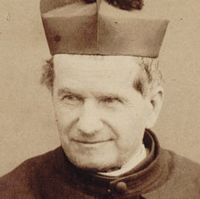
 By St John Bosco
Reading time: 16 min.
In the following recounted speech, delivered by Don Bosco between 30 April and 1 May 1868, the saint decides to share a dream with his young people that is as unsettling as it is revealing. Through the appearance of a monstrous toad and the vision of a vine representing the Oratory community, he unveils the spiritual struggle fought within every conscience, denounces the vices that threaten Christian life – pride and immodesty above all – and points to the remedies: obedience, prayer, sacraments, work, and study. His intention isn’t to frighten, but to shake them up: Don Bosco speaks as a caring father, eager to guide his “sons” towards conversion and the joy of a fruitful and lasting existence in the freedom of the children of God.
[Wednesday] April 29 [1868], Don Bosco made this announcement to the Oratory students: “Tomorrow night, Friday night, and Sunday night I’ll have something special to tell you. If I were to neglect this, I believe that I would have to die before my time. What I must say is far from pleasant. I wish the artisans to be present too.”
Accordingly, on the following night the artisans came from their portico, where Father Rua or Father Francesia usually addressed them after night prayers, and joined the students. Don Bosco addressed the assemblage:
My dear boys, last night I said that I had something unpleasant to tell you. It’s a dream I had. I wasn’t going to talk about it because I thought it was nothing but a dream and because, whenever I have narrated my dreams, remarks and objections have been made. Now, however, a second dream forces me to reveal the first, and all the more so considering that for the past few nights — particularly the last three nights — I have been repeatedly troubled by nightmares. You know that I went to Lanzo for a little rest. Well, on my last night there, no sooner had I fallen asleep than I dreamed that I saw a most loathsome toad, huge as an ox, enter my room and squat at the foot of my bed. I stared breathlessly as its legs, body, and head swelled and grew more and more repugnant, its green body, fiery eyes, red-lined mouth and throat, and small bony ears presenting a terrifying sight. Staring wildly, I kept muttering to myself: But a toad has no ears. I also noticed two horns jutting from its snout and two greenish wings sprouting from its sides. Its legs looked like those of a lion, and its long tail ended in a forked tip.
At the moment I seemed not a bit afraid, but when that monster began edging closer to me, opening its huge, tooth-studded jaws, I really became terribly frightened. I thought it was a demon from hell because it looked like one. I made the Sign of the Cross, but nothing happened. I rang the bell, but no one responded. I shouted, but in vain. The monster would not retreat. “What do you want of me, you ugly devil?” I asked. As if in answer, it just crept forward, ears fully stretched out and pointing upward. Then, resting its front paws on the top of the bedstead and raising itself on its hind legs, it paused momentarily, looked at me, and crawled forward on my bed until its snout was close to my face. I felt such revulsion that I tried to jump out of bed, but just then the monster opened its jaws wide. I wanted to defend myself and shove the monster back, but it was so hideous that even in my predicament I did not dare to touch it. I screamed and frenziedly reached behind me for the small holy water stoup, but I only hit the wall. Meanwhile the monstrous toad had managed to mouth my head so that half of my body was inside its foul jaws. “In the name of God,” I shouted, “why are you doing this to me?” At these words, the toad drew back and let my head free. Again I made the Sign of the Cross, and since I had now dipped my hand in the holy water stoup, I flung a few drops of water at the monster. With a frightening shriek it fell backward and vanished, while a mysterious voice from on high clearly said: “Why don’t you tell them?”
The director of Lanzo, Father Lemoyne, awakened by my prolonged screams, heard me pounding on the wall. “Don Bosco,” he asked me in the morning, “were you having nightmares last night?”
“Why do you ask?”
“Because I heard your screams.”
I realized that God willed I should reveal what I had seen. For this reason, and to rid myself of these nightmares, I have decided to tell you everything. Let us thank the Lord for His mercy. Meanwhile, let us strive to carry out His admonitions, no matter what way He may choose to make them known to us, and let us use the means He sends to enable us to save our souls. Through these dreams I have come to know the state of conscience of each of you.
I wish, though, that you keep within these walls what I am going to disclose to you. I beg you not to write about it or talk about it outside the house because such things are not to be ridiculed, as some people might do, and also because I want to avoid possible unpleasant complications. I tell you these things confidentially as a father to his beloved sons, and you should listen as though it were your own father telling them to you. Well then, here are the dreams which I would rather forget but must reveal.
I began to have these dreams on [Sunday] April 5, at the very beginning of Holy Week, and this went on for several miserable nights. These dreams so exhausted me that in the morning I felt more done in than if I had been working all night. They also alarmed and upset me very much. The first night I dreamed that I was dead: the second, that I was standing at God’s judgment seat to settle my accounts. Each time I awoke to realize that I was alive and had Time to prepare better for a holy death. The third night I dreamed that I was in heaven. I surely enjoyed that, but it all vanished when I woke up the next morning. I nevertheless felt determined, no matter what the cost, to gain that eternal kingdom which I had glimpsed. So far these dreams did not concern you in the least and would have meant nothing to you. When one falls asleep with something on his mind, his imagination goes to work and he dreams about it.
Anyway, I had another dream, and this is the one I must tell you. The night of Holy Thursday (April 9) I had hardly dozed off when I dreamed I was standing in these porticoes with our priests, clerics, and boys around me. Then all of you vanished, and I seemed to step into the playground with only Father Rua, Father Cagliero, Father Francesia, Father Savio, and young Preti. A little distance away stood Joseph Buzzetti and Father Stephen Rumi, a good friend of ours from the Genoa seminary. Suddenly the Oratory, as we now know it, changed its appearance and looked as it had been in its very beginning, when only those just mentioned were there. At that time our playground adjoined vast, untilled fields stretching up to the citadel meadows where our boys often strayed in their games.
We sat near the present cabinet shop under my bedroom window, where once we had a vegetable garden, and began talking about the house and the boys. Suddenly a gorgeous vine — the very one that used to be there — sprouted out of the ground in front of this pillar supporting the water fountain near the entrance of the old Pinardi shed. (The platform on which Don Bosco was standing was backed against this pillar.) We were astonished at the appearance of the vine after so many years, and we wondered how it could have happened. Meanwhile, the vine kept growing to about a man’s height, spreading countless shoots and tendrils into all directions until it covered the entire playground and stretched beyond it. Oddly, its shoots did not grow upward, but spread out parallel to the ground like a very vast arbor with no visible support. Its budding leaves were a deep green, and its shoots were astonishingly healthy and strong. Soon handsome clusters of grapes broke out, grew in size, and took on a purplish-red color.
“How can this vine have grown so quickly?” we asked each other in amazement. “What does it all mean?”
“Let’s wait and see,” I replied.
I kept watching the vine most carefully, when suddenly all the grapes fell to the ground and turned into a crowd of lively, cheerful boys. In no time the whole playground and the area covered by the vine were filled with boys who were jumping about, playing, and having a grand time. It was a sight to behold. There under that unusual arbor I could see all the boys who ever have been, are, or will be at the Oratory and in other Salesian schools. Very many were unknown to me.
You know that a guide always shows up in my dreams. Well, at this point a stranger appeared at my side and stood watching the boys with me. Then a mysterious curtain abruptly appeared before us, blotting out this joyous scene.
No higher than the vine itself, this curtain in its entire width seemed to be hanging from the shoots of the vine like a stage curtain. All we could see now was the upper part of the vine stretched out like an enormous green carpet. In the meantime the boys’ cheerful hubbub had quickly turned into gloomy silence.
“Look!” the guide told me, pointing to the vine.
I got closer. The lovely grape-laden vine had now nothing but leaves, bearing this inscription: Nihil invenit in ea! [He found nothing on it — Matt. 21, 19] Puzzled as to its significance, I asked my guide, “Who are you? What does this vine symbolize?”
In answer, he parted the curtain. Only a portion of the great many boys I had seen before were there now, most of them unknown to me.
“These boys,” he explained, “have plenty of opportunities for doing good, but they do not aim at pleasing God. They make believe they are doing good to keep up appearances, painstakingly obey house rules to avoid reprimands or loss of esteem, and are respectful toward superiors, but they do not profit by their teachings, exhortations, or efforts. All these boys strive for is some prominent, money-making position in the world. With no concern to discover their vocation, they readily reject the Lord’s call while they keep disguising their intentions lest they lose any advantage. In short, they are those who do things out of necessity and derive no good for eternity.”
How disappointed I was to see in that group several boys whom I believed to be very good, affectionate, and sincere!
“Unfortunately this is not all,” my guide continued, letting go of the curtain. “Look up there now.” And he pointed to the upper part of the arbor.
Among the leaves I could see clusters of grapes that looked very tasty. Happily I got closer and noticed that the grapes were pockmarked, overripe, moldy, wormy, pecked, rotten or shriveled — a total disaster. Their stench fouled the air.
Again the stranger lifted the curtain. “Look,” he said. I saw another throng of boys, but not the countless number as at the beginning of the dream. Formerly very handsome, they now appeared ugly, sullen, and covered with hideous sores, and they walked about with great melancholy as if stooped or wasted by age. No one spoke. All were past, present, and future pupils of ours. The last mentioned were the most numerous. They all looked dejected and did not dare raise their eyes.
My companions and I were dismayed and speechless. “What happened?” I finally asked my guide. “These boys, once so handsome and joyful — why are they now so ugly and melancholy?”
“Because of their sins,” was the answer, and as these boys were meanwhile walking past me, he added, “Take a good look at them.”
I noticed then that their foreheads and hands bore the name of each boy’s sin. To my great surprise, I recognized several boys. I had always believed them to be very virtuous; now I was discovering that hideous sores were festering in their souls.
As they filed past, I could read on their foreheads: Immodesty, Scandal, Malevolence, Pride, Idleness, Gluttony, Envy, Anger, Vindictiveness, Blasphemy, Impiety, Disobedience, Sacrilege, Theft.
“Not all the boys are as you see them now.” my guide remarked, “but they will be so one day if they do not change their ways. Many of these sins are not serious in themselves, but they will lead to serious falls and eternal perdition. Qui spernit modica, paulatim decidet [He who despises trifles will sink down little by little — Sir. 19, 1]. Gluttony breeds impurity, contempt for superiors leads to contempt for priests and the Church, and so on!
Downhearted at such a sight, I took my notebook and pencil to jot down the names of the boys I knew and their sins, or at least their predominant sin, so that I might warn and correct them. But the guide held my arm. “What are you trying to do?” he asked.
“I want to jot down what’s written on their foreheads in order to warn them so that they may amend their lives.”
“You may not do that.”
“Why not?”
“They have all they need to go through life unscathed. They have house rules; let them observe them. They have superiors; let them obey them. They have the sacraments; let them receive them. They have Penance; let them not profane it by concealing different sins. They have the Holy Eucharist; let them not partake of it in the state of mortal sin. Let them check their eyes, avoid bad companions, bad books, foul conversations, and so on. Keeping the house rules will save them. Let them promptly obey the bell; let them stop trying to fool their teachers so as to idle away their time. Let them willingly obey their superiors instead of looking upon them as boresome watchdogs, self-interested counselors, or even enemies. Let them not consider it a great victory when they succeed in concealing their wrongdoings and escaping punishment. Let them be reverent in church and pray willingly and devoutly without disturbing others or chattering. Let them study when it’s time to study, work when it’s time to work, and behave at all times. Study, work, and prayer are the things that will keep them good.”
Notwithstanding his prohibition, I kept pestering my guide to let me write down the boys’ names. At this, he snatched my notebook and threw it on the ground, saying, “For the last time, I say there is no need to write down their names. God’s grace and the voice of conscience will tell your boys what to do and what not to do.”
“Does this mean,” I asked, “that I cannot tell my dear boys anything of what I have seen? Have you any suggestion for them?”
“You may tell them whatever you will remember,” he replied.
He again let the curtain drop and once more we saw the vine. Its nearly leafless shoots held handsome clusters of ruddy, full-grown grapes. I went closer and found them to be as good as they looked. Their delightful sight and pleasant smell made my mouth water.
Again my guide lifted the curtain. Under that arbor I once more saw many boys — our present, past, and future pupils. They were handsome beyond compare and radiant with joy.
“These,” the stranger explained, “are the boys who, thanks to your care, are yielding or will yield good fruit. They are those who practice virtue and will greatly console you.”
Delighted though I was, I somehow also felt grieved that their number was not as great as I had hoped. As I stood watching them, the bell rang and the boys left. The clerics who were with me went to their tasks. I looked about me and found myself alone. The vine was gone and my guide had vanished. At this point I woke up and was able to get a little rest.
On Friday, May 1, Don Bosco continued his narrative:
As I told you last night, I awoke thinking I had heard the bell ring, but then I returned to sleep. Suddenly somebody shook me. I found myself in my room, answering my mail. Afterward, I walked to the balcony, gazed for a moment at the majestic dome of our new church, and then went downstairs and stepped into the porticoes. At short intervals, priests and clerics came from their various assignments and crowded around me, among them Father Rua, Father Cagliero, Father Francesia, and Father Savio. As I stood chatting with them, the Church of Mary, Help of Christians, and all our present buildings abruptly disappeared, and we found ourselves in front of the old Pinardi shed. [As in the previous dream] a vine sprouted up in exactly the same place, as if from the same roots, grew to the same height, and then spread its shoots horizontally throughout a very vast area. The shoots in turn sprouted leaves; then there came clusters of grapes that ripened under my very eyes. But no boys were to be seen. The bunches of grapes were truly enormous, like those of the Promised Land. One of them would have taxed the strength of a man. The perfectly ripe, golden grapes were oblong and extraordinarily large so that a single one would have been quite a mouthful. Briefly, they looked so good as to make one’s mouth water. “Eat me,” they seemed to say.
Father Cagliero and the other priests marveled, while I kept exclaiming, “How gorgeous they are!”
Unceremoniously Father Cagliero plucked a few grapes and put one in his mouth. No sooner did he sink his teeth into it than he spat it out so forcefully that we thought he was vomiting. The grape had the taste of a rotten egg. “Goodness gracious!” he exclaimed after much spitting. “What stuff! It’s enough to kill a man!”
We all stood speechless. At this moment, a serious-looking man came out of the sacristry of the old chapel and determinedly strode up to me.
“How can such beautiful grapes taste so rotten?” I asked him. As if in answer, he gravely fetched a bundle of sticks, picked a well-knotted one, and offered it to Father Savio, saying, “Take this and thrash these shoots!” Father Savio refused and stepped back. The man then approached Father Francesia, but he too declined. The stranger then turned to Father Cagliero and, taking him by the arm, tried to press the stick in his hand. “Take it and strike!” he said. “Thrash and knock down. ” So saying, he pointed to a certain spot. Startled, Father Cagliero stepped back. “Are you joking?” he exclaimed, striking his fist into his other hand. But the stranger insisted, “Take it and strike!” “Not I!” Father Cagliero shot back. Then he hid behind me in fright.
Foiled but unperturbed, the stranger turned to Father Rua who, like Father Cagliero, took refuge behind me. The man then came up to me. “Take this stick and strike those shoots,” he commanded. I made a great effort to see whether I was dreaming or awake, but it all seemed very real to me.
“Who are you?” I asked. “Why must I knock these shoots to the ground? Am I dreaming? Am I imagining things? Are you speaking to me in God’s name?”
“Draw closer to the vine,” he answered, “and see what’s written on those leaves!” I complied and read: Ut quid terram occupat? [Why does it still encumber the ground? — Luke 13, 7].
“That’s from the Gospel,” my guide exclaimed.
“Yes,” I remarked, “but remember that in the Gospel we also read that Our Lord allowed the vinedresser to dig around it and manure it, putting off its destruction until every attempt had been made to help it bear good fruit.”
“All right. We will postpone the punishment. Meanwhile, take a look.” So saying, he pointed to the vine. I looked but could not understand what he was driving at.
“Come here,” he said, “and read what’s written on the grapes.”
I noticed then that they bore the name of each pupil and his predominant sin. I was aghast at what I saw. I was particularly frightened by such inscriptions: “Proud, Unfaithful to His Promises, Unchaste, Two-Faced, Neglectful of His Duties, Calumniator, Vindictive, Heartless, Sacrilegious, Contemptuous of Authority, Stumbling Block, Follower of False Doctrines. I saw the names of those quorum deus venter est [whose god is their belly]; of those who scientia inflat [are bloated by knowledge]; of those who quaerunt quae sua sunt, non quae Jesus Christi [seek their own interests, not Our Lord’s]; of those who scheme against their superiors and the house rules. Those names identified past, present, and future pupils of ours. The last mentioned — quite a number of them — were unknown to me.
“This is the fruit we get from this vineyard,” the man said gravely — “bitter, bad, and harmful to eternal salvation.”
I immediately tried to jot down some names in my notebook, but again my guide stopped me. “What are you up to?” he asked.
“Please let me take down the names of those I know so that I may warn them privately .and correct them,” I pleaded.
It was no use. He would not consent.
“If I tell my boys the pitiful state they are in, they will amend their lives,” I insisted.
“If they do not believe the Gospel,” he replied, “they won’t believe you either.”
I kept insisting that I wanted to take some notes for the future, but, ignoring me, he walked up to Father Rua with the bundle of sticks.
“Take one,” he told him, “and strike the vine.” Crossing his arms, Father Rua bowed his head and, murmuring “Patience,” glanced at me. I nodded approval. Father Rua then grabbed a stick, got close to the vine, and began to beat it at the spot indicated. He had hardly dealt a blow when the guide motioned him to stop and shouted to all of us to step back.
We all withdrew a certain distance. From where we stood we could see the grapes swell up and, though retaining their golden color and oblong shape, become hideous masses resembling’ shell-less snails. Again the guide shouted: “Watch now: the Lord takes His vengeance!” Immediately the sky darkened and a dense fog covered the vine entirely from our sight. Through the darkness lightning flashed, thunder roared, and dreadful thunderbolts struck everywhere over the playground. The vine shoots bent under the furious wind and all the leaves were stripped away. Finally a hailstorm hit the vine. I tried to flee, but my guide held me back. “Look at the hail!” he said.
I noticed that the hailstones, big as eggs, were either black or red, each pointed at one end and flat at the other, like a mallet. Those nearest to me were black but beyond I could see the red ones.
“It’s weird!” I exclaimed. “I never saw hailstones like these.”
“Get closer,” the stranger said, “and you will see something else.”
I complied, but an awful stench made me draw back immediately. At the man’s insistence, I picked one up to examine it, but, unable to stomach the smell, I dropped it instantly. “I couldn’t see anything,” I said.
“Try again,” he replied.
Overcoming my revulsion, I took up a black hailstone and read on it: “Immodesty.” Then I walked over to the red hailstones. Though ice-cold, they started fires wherever they fell. I picked one up. It still smelled very badly, but I found it easier to read on it: “Pride.” Somewhat embarrassed by these findings, I asked, “Are these then the two main vices threatening this house?”
“These are the two main vices that ruin most souls not only in your house but all over the world. In due time, you will see how many will plunge into hell because of them.”
“Then what must I tell my sons to make them abhor them?”
“You will soon find out,” he said and moved away from me. Meanwhile hailstones kept pelting the vine furiously amid thunder and lightning. The grapes were now a mess, looking as if they had been thoroughly crushed by vintners’ feet in a vat. The juice fouled the air with such a sickening stench that it was hardly possible to breathe. Each grape gave out a foul smell of its own, each more repelling than the other, depending on the number and kind of sin. Unable to stand it, I put my handkerchief to my nose and turned to go to my room. I realized then that I was utterly alone. Father Francesia, Father Rua, Father Cagliero, and all the others had fled. In that silence and solitude I became so frightened that I broke into a run and woke up.
As you see, this was a very nasty dream, but what happened the following night was much worse. I’ll tell you about it soon. What these dreams imply are at present beyond your understanding. I shall explain them in due time. It is late now, and so I’ll let you go to bed.
We must bear in mind that the grave faults revealed to Don Bosco did not all refer to that specific year but to future years as well. He not only saw all his past and present Oratory pupils but countless others, unknown to him, who would attend his schools throughout the world. Similarly, the parable of the fruitless vine in the Book of Isaiah spans several centuries.
Furthermore, we should not forget for a moment what the guide said: “Not all the boys are now as you see them, but they will be so one day unless they mend their ways.” The path of evil leads to the abyss.
We also wish to point out that after the appearance of the vine a stranger came upon the scene who, though not immediately recognized by Don Bosco, later acted as his guide and interpreter. In narrating these and other dreams, Don Bosco occasionally called him “a stranger” in order to play down what was most striking about his dreams and — let us say it — what too clearly indicated a supernatural intervention.
Taking advantage of the intimacy with which he honored us, we often asked him about this “stranger.” Though we did not get a clear-cut answer, we became convinced through other clues that the guide was not always the same. In turn, he may have been an angel, a deceased pupil, St. Francis de Sales, St. Joseph, or some other saint. On certain occasions, as Don Bosco explicitly stated, Louis Comollo, Dominic Savio, and Louis Colle had acted as guides. Sometimes, too, other personages appeared along with them.
(MB IT IX, 154-165 / MB EN IX, 75-84)